

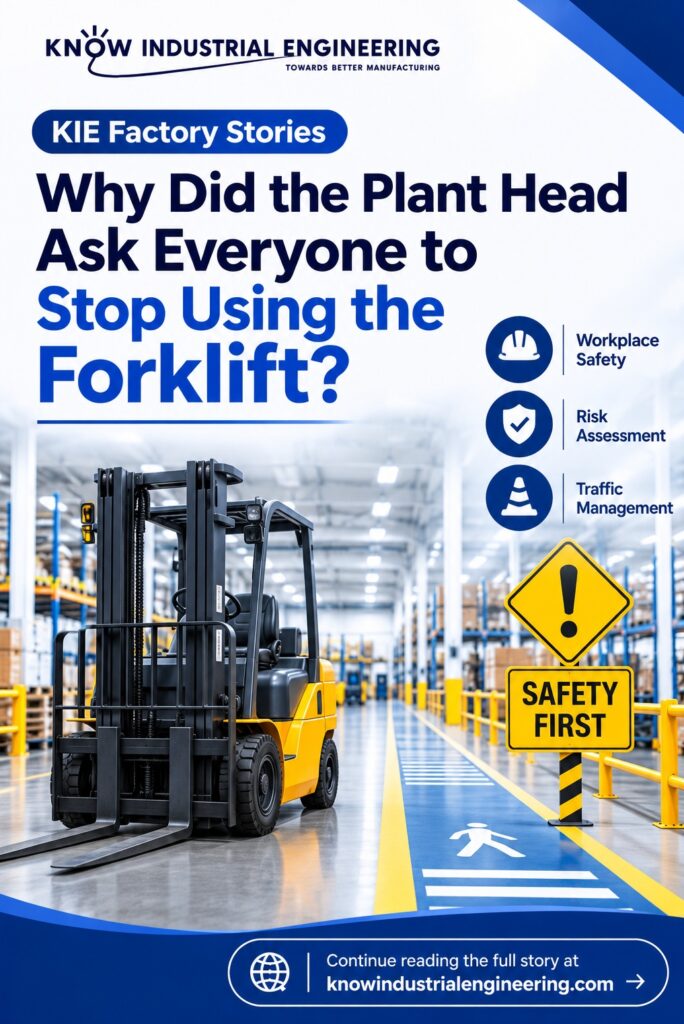
“Who authorized this decision? We have materials to move!”
The Warehouse Manager was furious.
The Plant Head had temporarily stopped forklift movement in one section of the factory.
There had been no accident.
No equipment failure.
No major safety complaint.
But during a factory walk, the Plant Head had noticed something.
Operators were walking through the same narrow aisle used by forklifts.
Some were carrying components.
Others were pushing trolleys.
A few forklifts were reversing because there was no clear turning space.
Everyone was following their own delivery schedule.
But nobody was looking at the combined movement of people and vehicles.
The Plant Head asked the Safety Manager to study the area.
They introduced separate pedestrian walkways, marked forklift routes, controlled crossing points and one-way movement wherever practical.
They also reviewed material delivery timings to reduce unnecessary traffic.
Forklift movement resumed under the new arrangement.
The factory had not reduced material movement.
It had made material movement safer.
This is the importance of Traffic Management and Risk Assessment in manufacturing.
Safety is not just about asking people to be careful. It is about identifying how different activities interact and designing the workplace to control those risks.
A factory should never depend on luck to keep people safe.
Good production planning moves materials. Good safety planning protects the people moving them.
Now or Never
We’ve got your back on your manufacturing journey — Stay in touch
Follow us for step-by-step guidance, templates, and insights that save time and reduce mistakes.
Know Industrial Engineering Platform – Helping manufacturing industry professionals worldwide since 2019
Discover more from Know Industrial Engineering
Subscribe to get the latest posts sent to your email.