



In this article we will learn about calculation of Inventory Turnover Ratio. Also, you will be able to download a master excel template for easily calculating Inventory Turnover Ratio (ITR).
Now a day to run a business successfully revenue generation & customer order cycle time reduction is a very important parameters of any business.
In short Inventory Turnover Ratio (ITR) Measures how fast company convert inventory into revenues.
Higher the inventory turnover ratio, faster a company is capable of converting inventory into cash or sell its products.
It also gives the insights on how many days a company takes to sell its inventory or products. Lower the no of days, better its conversion.
Before we proceed further to formula & calculative part of Inventory Turnover Ratio (ITR), we need to understand what is inventory and its impact on business performance.
What Is Inventory?
Inventory is materials or goods, used to add value & fulfil customers’ requirements with the help of manufacturing or assembly processes.
In a simple way Inventory is a basic requirement to producing certain products or assembly of products.
Majority of inventory categorized into three types.
- Raw Material
- Work-In-Progress (WIP)
- Finished Goods.
Now, to understand Inventory further, let’s jump to Its impact on any business.
Business Impact of Inventory
Basically to run a any factory in financial perspective majority of cost contributors excluding premises or land area, is inventory. And, If we Improve the inventory ratio it directly impact on cash cycle reduction or improve revenue generation cycle in many business.
Now, to understand above sentence we are going to formula for calculating Inventory Turnover Ratio.
Formula for calculating Inventory Turnover Ratio ( ITR)
Inventory Turnover Ratio (ITR) = Cost of Goods Sold / Average Inventory
Here, Cost of Goods Sold (COGS) means direct operating expenses to run a business. Majority of industries direct expenses is considered as direct material cost & direct labour cost.
Too calculate cost of good sold please refer below formula.
COGS = ( value of starting inventory + value of Inventory purchases – value of closing inventory ) + ( direct labour cost )
Average Inventory = (Inventory Opening Stock + Inventory Closing Stock) / 2.
Now, we understand Inventory opening stock & Inventory closing Stock in the following paragraph.
If you are calculating monthly average inventory, to calculate inventory opening stock, measure the inventory at 1st day of month & to calculate inventory closing stock measure the inventory at last day of the month.
Now, Let’s jump to calculation of Inventory Turnover Ratio (ITR) with the help of an example.
Example: –
XYZ Bearing is located at Ahmadabad location, review certain financial parameters listed below & calculate yearly Inventory Turnover Ratio & no of day basis. And also calculate individual inventory turnover ratio.
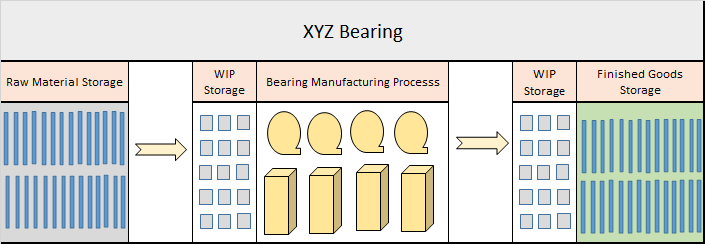
COGS (Operating Expenses) = $93196
Raw material opening stock = $12500
Raw material closing stock = $9570
WIP opening stock = $1500
WIP closing stock = $1250
Finished good opening stock = $7500
Finished good closing stock = $8200
All above listed financial parameters period on yearly basis.
Solution: –
Formula to calculate Average Inventory = (Inventory opening stock + Inventory closing stock) / 2
RM : ($12500+$9570) / 2 = $11035
WIP : ($1500+$1250) |/2 = $1375
FG : ($7500+$8200) /2 = $7850
Total Average Inventory = RM + WIP + FG = $11035 + $1375 + $7850 = $20260
Inventory Turnover Ratio (Overall) = (COGS) / Avg. Inventory
= ($93196 / $20260)
ITR = 4.6 Times
This means COGS is 4.6 times its average inventory cost.
To, calculate in terms of no of day basis = 365/4.6 = 79.34 days
This means, in every 79.34 days average inventory of the company is converted into revenue.
Raw material ITR = (COGS) / Avg. Raw material Inventory
= ($93196 / $11035)
= 8.44 Times
To, calculate in terms of no of day basis = 365/8.44 = 43.24 days
Work-In-Progress ITR = (COGS) / Avg. Work-In-Progress Inventory
= ($93196 / $1375)
= 67.77 Times
To, calculate in terms of no of day basis = 365/67.77 = 5.38 days
Finished goods ITR = (COGS) / Avg. Finished goods Inventory
= ($93196 / $7850)
= 11.87 Times
To, calculate in terms of no of day basis = 365/11.87 = 30.74 days
Conclusion :- Inventory Turnover Ratio (Overall) – 4.6 means ITR per year is 4.6 times, that means on each 79 days your inventory turn into revenue generation for a period of year.
A part for process improvement perspective for improve this factor, COGS is almost fixed or minor deviation either positive side or negative side but we need to focused on to reduce Avg. Inventory to improvise ITR Ratio as well as improvised Revenue Generation Cycle.
Ideal Inventory turnover ratio
Ideal inventory turnover ratio of industries is generally between 5 to 10 but it varies as per industrial product to product. On excellence point of you, you can initially start monitoring ITR ratio & focused to improve it.
And there is no standard reason for this ideal ratio but majority of industries are maintaining this ratio for better practice.. You can also improvise more than this but it’s varies on industrial product.
Excel template for calculating Inventory turnover ratio
Click the download button below to download the excel template.

Thank You

Now or Never
We’ve got your back on your manufacturing journey — Stay in touch
Follow us for step-by-step guidance, templates, and insights that save time and reduce mistakes.
Know Industrial Engineering Platform – Helping manufacturing industry professionals worldwide since 2019
Discover more from Know Industrial Engineering
Subscribe to get the latest posts sent to your email.

Excellent sir