


People working in the field of Process improvement must be known to the term “SIPOC”. But, for those who are unaware of it, you guys are at the right place.
How to Pronounce SIPOC
Pronunciation: sigh pock (SIPOC)
SIPOC stands for
Principle: SIPOC is the Six Sigma tool used to visually represent a “High Level Process Map”. The acronym stands for:
S- Supplier
I- Inputs
P- Process
O- Outputs
C- Customer
Difference between SIPOC and Process map
The tool is called “High Level Process Map” because, unlike other processes wherein we put every requirement of the process and also more detailing is done, SIPOC only offers the brief level of information in form of Suppliers, Input, Process, Output and Customers.
The major difference between other maps and SIPOC is the addition of Suppliers and Customers. And we know, how much importance the Customers have in Lean Six Sigma concept.
Because of the gravity of Customers in Six Sigma, many organizations use the opposite acronym i.e. COPIS, giving customers and their values more priority.
SIPOC definition
Let us see, the five areas which SIPOC covers:

SIPOC and Six Sigma
Almost every time, SIPOC is used in the “Define” phase of DMAIC, as it gives clear idea to the audience regarding the brief process, before continuing to the detailed part.
Benefits of SIPOC
- Helps to identify Strength, weakness, threats and opportunities in the process
- It provides an overall viewpoint of the process
- Helps to identify whole process in a go
- To update or refresh the memories of the people known to process but faded
- Helps to train new employees
- Increases transparency in the industry
Information we gets from SIPOC analysis
- By letting know, the scope of the process
- What is the start and end point in the process?
- What are the inputs and outputs of the process?
- Potential customers
- Potential Suppliers
- What are the customers’ demands?
How to create SIPOC diagram
Step I
There are many approaches to make SIPOC, but the general rule is to start with the process step.
Note: Try not to exceed the process steps more than 7.
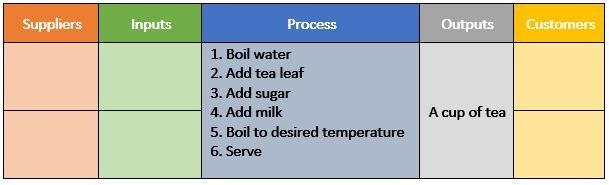
Let us take an example of making A Cup of Tea

Step II
Identify all the outputs of the process.
In this case, it will be a cup of tea.
Step III
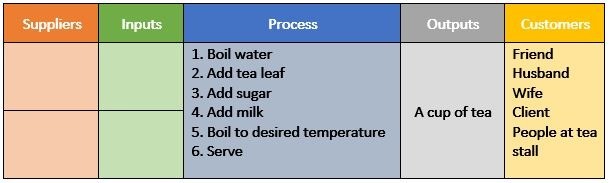
Identify all the potential customers for the Tea
Step IV
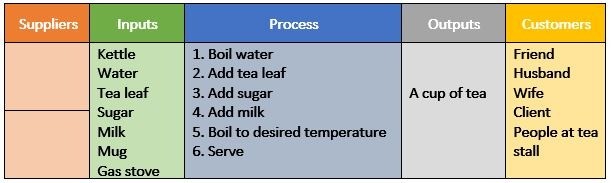
Check out all the Inputs that we need to successfully implement the procedure
Step V
The final step would be to identify all the suppliers that can help to supply the necessary items listed in inputs column

Step VI
The final step will be to share the diagram with all the stakeholders to evaluate and make any necessary changes.
Conclusion
Here, we can see that the High Level Process Map is completed. One can easily identify the brief process to prepare Tea. In addition to it, any changes to be made can be known just by the glimpse at the process.
However, this is just a simple example that one can take back and begin their own SIPOC diagram.
In Industries, Shopping malls, Service sectors and many more, one can easily prepare this diagram without any prior knowledge of Six Sigma or Lean Management to understand the process and do Gap analysis.
Thank You
If you know any subject that can be related to manufacturing industry or industrial engineering, you can earn some income by becoming article contributor of this website. For knowing more about it, please visit Join us page.
You don’t need to have any experience in article writing, just knowledge on the subject is needed.
Also you can know more about our team of article contributors by visiting the about us page.
About the Author

Jay Desai has over 4 years of experience in Lean Six Sigma, Operations Management and Production Engineering. A post graduate in Computer Integrated Manufacturing from Nirma University. He has successfully delivered Lean deployment, training and project coaching at many levels within customers organization as well as delivered educational programmes.
Latest articles from Know Industrial Engineering
- What is a Spaghetti Diagram and How Does It Improve Factory Layout?What is a Spaghetti Diagram? A Spaghetti Diagram is a visual tool used in Industrial Engineering to map the actual movement of people, materials, or equipment through a workplace. Advertisement The movement paths often look like tangled spaghetti, revealing unnecessary travel and inefficient layouts. In simple terms Instead of guessing why an operator spends too… Read more: What is a Spaghetti Diagram and How Does It Improve Factory Layout?
- KIE Factory Stories: Why Did the Plant Head Ask for a Smaller Warehouse?“We need more storage space.” The Warehouse Manager was convinced. Advertisement Finished goods were filling every available corner. Pallets were blocking aisles, and the team was struggling to find space for incoming material. His solution was simple. Build a bigger warehouse. But the Plant Head asked him to check one number first. “How many days… Read more: KIE Factory Stories: Why Did the Plant Head Ask for a Smaller Warehouse?
- What is Performance Rating in Time Study?What is Performance Rating? Performance Rating is the assessment of an operator’s working pace compared with a defined normal performance level during a time study. Advertisement It helps an Industrial Engineer adjust observed time when the operator is working faster or slower than the normal pace. In simple terms If an operator completes a task… Read more: What is Performance Rating in Time Study?
- KIE Factory Stories: Why Did the Engineer Remove a Safety Sign?“Who removed the warning sign?” The supervisor was not happy. Advertisement The sign had been placed beside a machine after a small hand injury. Everyone knew the area was dangerous. But the sign was gone. The safety engineer had removed it. The supervisor stared at him. “Why would you remove a safety warning?” The engineer… Read more: KIE Factory Stories: Why Did the Engineer Remove a Safety Sign?
- What is Standard Time in Industrial Engineering and Why Is It Important?What is Standard Time? Standard Time is the time allowed to complete a specific task under defined working conditions, including appropriate allowances for fatigue, personal needs, and unavoidable delays. Advertisement It helps establish a realistic expectation for how long a properly trained operator should take to complete the work. In simple terms If an operator’s… Read more: What is Standard Time in Industrial Engineering and Why Is It Important?
- KIE Factory Stories: Why Did the Purchase Manager Reject the Cheaper Supplier?“We can save ₹8 per piece if we switch suppliers.” The Purchase Manager expected everyone to agree. Advertisement Instead, the Plant Head asked one question: “How much will we really save?” The supplier’s price was lower. But there was a catch. The new supplier delivered in larger batches. That meant more inventory. Their lead time… Read more: KIE Factory Stories: Why Did the Purchase Manager Reject the Cheaper Supplier?
- What are Value-Added and Non-Value-Added Activities in Manufacturing?What is a Value-Added Activity? A value-added activity is an activity that changes the product in a way the customer requires and is willing to pay for. Advertisement Examples: What is a Non-Value-Added Activity? A non-value-added activity consumes time, effort, space, or resources without increasing the value of the product. Examples: Simple Example Consider an… Read more: What are Value-Added and Non-Value-Added Activities in Manufacturing?
- Stories from the Factory Floor #06“Just increase the speed.” That was the Plant Manager’s answer. Advertisement The customer order had increased, and the factory was struggling to meet the target. The team increased the machine speed. Output went up. Everyone was happy. For a while. Then the rejection rate started climbing. Operators were rushing. Minor breakdowns became frequent. Rework increased.… Read more: Stories from the Factory Floor #06
- What is Ergonomics in Manufacturing and Why Does It Matter?What is Ergonomics? Ergonomics is the science of designing workstations, tools, equipment, and tasks to fit the worker. Advertisement The goal is to make work safer, more comfortable, and more efficient. In simple terms Instead of asking: “How can the operator adapt to the workstation?” Ergonomics asks: “How can we design the workstation so the… Read more: What is Ergonomics in Manufacturing and Why Does It Matter?
- Stories from the Factory Floor #05“We have always done it this way.” The sentence came up three times during the meeting. Advertisement The team was discussing a process that required six approvals before a job could move to production. Nobody could explain why all six were still necessary. So they went looking. Approval 1 was added after a quality issue… Read more: Stories from the Factory Floor #05
- What are the 8 Wastes in Lean Manufacturing?What is Waste in Manufacturing? In Lean Manufacturing, waste means any activity that consumes resources but does not add value from the customer’s perspective. Advertisement A process can look busy and still contain significant waste The 8 Wastes Simple Example An operator produces a component in 30 seconds, but spends another 10 seconds walking to… Read more: What are the 8 Wastes in Lean Manufacturing?
- Stories from the Factory Floor #04The customer called three times. Same complaint. Advertisement “The product is good, but it is difficult to use.” Quality checked the product. It passed every test. Production checked the process. Everything was within standard. Engineering checked the drawings. No problem there either. So the team visited the customer. They watched how the product was actually… Read more: Stories from the Factory Floor #04
- What are Manufacturing KPIs and Why Are They Important?What is a Manufacturing KPI? A Manufacturing KPI (Key Performance Indicator) is a measurable value used to understand how effectively a manufacturing process is performing. Advertisement KPIs turn production performance into data that can be monitored and improved. In simple terms Instead of saying: “Production seems slow.” A KPI helps quantify it: Output = 8,500… Read more: What are Manufacturing KPIs and Why Are They Important?
- Stories from the Factory Floor #03“Don’t change anything.” That was the instruction from the Production Manager. Advertisement The line had been running for years. Same machines. Same layout. Same work method. Same problems. One young engineer noticed that operators were making the same small adjustment almost every hour. She asked why. An operator replied: “Because the machine doesn’t work properly… Read more: Stories from the Factory Floor #03
- What is Performance Rate and Why Is It Important in Manufacturing?What is Performance Rate? Performance Rate measures how fast a machine or production process operates compared with its ideal or planned production speed while it is running. Advertisement It helps answer: “When the machine is running, is it producing as fast as it should?” In simple terms A machine may be available for production but… Read more: What is Performance Rate and Why Is It Important in Manufacturing?
- Stories from the Factory Floor #02“Why are we producing this?” Nobody answered. Advertisement The Production Manager looked at the planning sheet. The order was approved. The material was available. The machine was ready. So production continued. Two days later, the finished products were sitting in the warehouse. Nobody was asking for them. The Planning Manager checked the customer order. The… Read more: Stories from the Factory Floor #02
- What is Quality Rate and Why Is It Important in Manufacturing?What is Quality Rate? Quality Rate measures the proportion of produced units that meet the required quality standards compared with the total units produced. Advertisement It helps answer: “How much of what we produced was good without being rejected?” In simple terms If a process produces 1,000 units and 30 units are defective: Good units… Read more: What is Quality Rate and Why Is It Important in Manufacturing?
- Stories from the Factory Floor #01“We don’t have it.” The Plant Head thought he had heard wrong. Advertisement “What do you mean?” “One component is out of stock.” The entire production line was ready. Operators were waiting. Machines were ready. Orders had to be shipped. The missing component? It cost less than ₹20. “Check the warehouse.” Nothing. “Check incoming material.”… Read more: Stories from the Factory Floor #01
- What is Voice of the Customer (VOC) and Why Does It Matter in Manufacturing?What is Voice of the Customer? Voice of the Customer (VOC) is the process of collecting and understanding customer needs, expectations, requirements, and feedback. Advertisement It helps manufacturers understand what customers actually value not just what the company assumes they value. In simple terms A customer may say: “I need faster delivery.” But the real… Read more: What is Voice of the Customer (VOC) and Why Does It Matter in Manufacturing?
- What is PMTS and How Can It Help Determine Standard Time?What is PMTS? PMTS stands for Predetermined Motion Time System. Advertisement It is a work measurement technique used to determine the time required to perform a task by analyzing the basic human motions involved, rather than measuring the entire task repeatedly with a stopwatch. In simple terms Instead of asking: “How long did this operator… Read more: What is PMTS and How Can It Help Determine Standard Time?
- What is Heijunka and How Does Production Leveling Improve Factory Flow?What is Heijunka? Heijunka is a Lean manufacturing method used to level production volume and product mix over time. Advertisement Instead of allowing demand fluctuations to create highly uneven production schedules, the goal is to create a smoother and more predictable workload. In simple terms Imagine customer demand requires: A factory could produce all of… Read more: What is Heijunka and How Does Production Leveling Improve Factory Flow?
- What is Production Mix and Why Does It Matter in Manufacturing?What is Production Mix? Production Mix refers to the combination and quantity of different products a factory produces during a specific period. Advertisement A factory may have enough total capacity, but the product mix can still create a capacity problem. In simple terms Suppose a factory produces: 🔹 Product A🔹 Product B🔹 Product C Each… Read more: What is Production Mix and Why Does It Matter in Manufacturing?
- What is Production Planning and Control (PPC) and Why Is It Important?What is Production Planning and Control? Production Planning and Control (PPC) is the process of deciding what to produce, how much to produce, when to produce it, and how to control the production process to meet customer requirements. Advertisement In simple terms PPC connects: Customer Demand → Production Plan → Materials → Machines → Manpower… Read more: What is Production Planning and Control (PPC) and Why Is It Important?
- What is Queue Time and How Does It Affect Manufacturing Lead Time?What is Queue Time? Queue Time is the time a job spends waiting before the next operation can begin. Advertisement The product is not being processed during this period it is simply waiting. In simple terms Manufacturing time can include: Processing Time + Waiting Time + Movement Time + Inspection Time A product may require… Read more: What is Queue Time and How Does It Affect Manufacturing Lead Time?
- What is Downtime Analysis and How Can It Improve Production?What is Downtime Analysis? Downtime Analysis is the systematic study of when, why, and how long production equipment or processes remain unavailable for production. Advertisement Instead of simply recording: “Machine stopped for 2 hours.” Industrial Engineers investigate: “Why did it stop, how often does it happen, and what is causing the biggest loss?” In simple… Read more: What is Downtime Analysis and How Can It Improve Production?
- What is Resource Utilization and Why Does It Matter in Manufacturing?What is Resource Utilization? Resource Utilization measures how effectively available manufacturing resources are being used compared with their available capacity. Advertisement Resources can include: In simple terms If a machine is available for 8 hours but actually produces for only 6 hours, its utilization is: 6 ÷ 8 × 100 = 75% The remaining 25%… Read more: What is Resource Utilization and Why Does It Matter in Manufacturing?
- Revisiting my Production Engineering subjects: SCT College, 2006–2010By Melvin Vincent In 2006, I joined Sree Chitra Thirunal College of Engineering, Trivandrum, to pursue B.Tech in Mechanical Engineering, Production Engineering stream, under the University of Kerala. I graduated in 2010. Advertisement Years later, I feel like opening those books again. Some lessons have stayed with me; others need a little refreshing. I am… Read more: Revisiting my Production Engineering subjects: SCT College, 2006–2010
- Elon Musk Says Money Won’t Matter in the Future. Is It Already Happening?Elon Musk has repeatedly discussed a future where AI and robotics could create such enormous productivity that many goods and services become extremely abundant. It sounds difficult to imagine. Advertisement But look at the past. We may already have experienced smaller versions of the same transformation. Things That Once Cost Money but Are Now Almost… Read more: Elon Musk Says Money Won’t Matter in the Future. Is It Already Happening?
- What leads to recent 4.3 Million EVs Recall – An analysisIn August 2026, nine vehicle manufacturers announced recalls covering approximately 4.276 million electric vehicles in China. The recalls centred on a safety mechanism that was already present in the affected vehicles: the mechanical emergency door release. This was not simply a case of millions of defective door latches. The concern arose from what could happen… Read more: What leads to recent 4.3 Million EVs Recall – An analysis
- Understand how money works through This story of Adam and BenImagine Earth thousands of years ago. There is only one man. Let’s call him Adam. Advertisement Adam wakes up hungry. He catches a fish. He eats it. Later, he wants shelter. So he cuts some wood and builds a small hut. He wants water. He walks to the river and collects it. There is no… Read more: Understand how money works through This story of Adam and Ben
Now or Never
We’ve got your back on your manufacturing journey — Stay in touch
Follow us for step-by-step guidance, templates, and insights that save time and reduce mistakes.
Know Industrial Engineering Platform – Helping manufacturing industry professionals worldwide since 2019
Discover more from Know Industrial Engineering
Subscribe to get the latest posts sent to your email.

Crisp and informative
Precisely explanation of SIPOC. Easy to understand language.
Well explained. It really helps to understand concepts on high level. Keep sharing such informative topics.