


Karakuri in manufacturing refers to smart, mechanical solutions that harness basic physical principles like gravity, levers, springs, pulleys, and counterweights to support operators and streamline tasks—without relying on electricity, motors, or automated systems.
What’s the coolest automation you’ve seen?
Maybe a robotic arm that moves like a dancer. Or a voice-controlled machine that actually listens. Or something so digital, it blurs the line between real and virtual.
Now flip that.
Picture solving a production line problem with no power, no sensors, and zero code… Just springs. Levers. Gravity.
That’s karakuri.
And no, it’s not some nostalgic tribute to the past. It’s a clever, working solution we’ve actually used on our shopfloor.
Karakuri: More Than Just an Old Trick
The word “karakuri” might remind you of those Japanese automaton dolls that serve tea- intricate devices powered by nothing but tension and clever mechanics.
Centuries later, the same principle is quietly driving change in modern factories.
Why? Because it works. Especially when you’re chasing lean goals- lower cost, shorter takt time, fewer breakdowns- without burning through your automation budget.
Karakuri Example
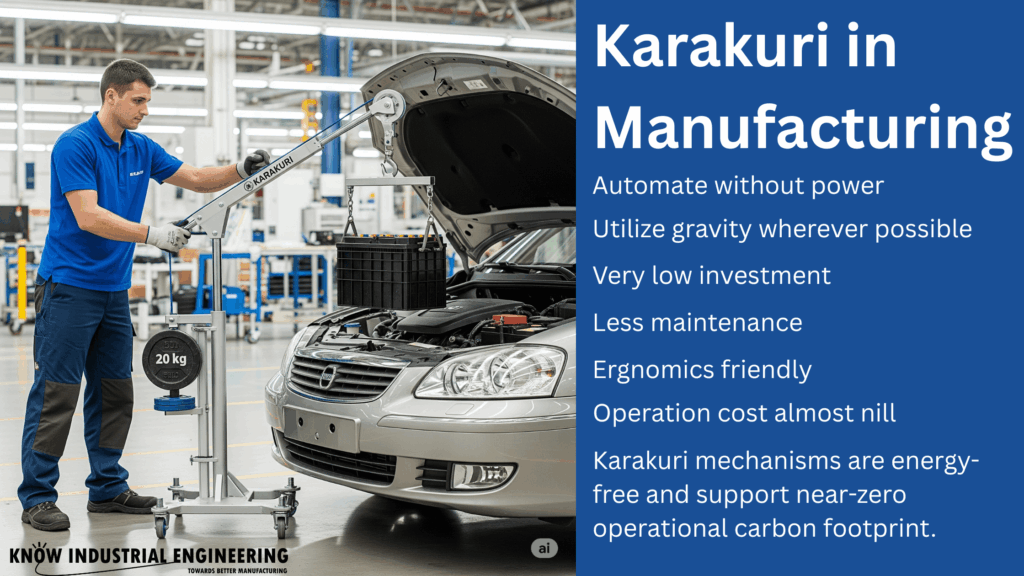
We had a common challenge. Operators were manually lifting 25-30 kg batteries multiple times a shift. Fatigue was high. Line speed was slipping. The ergonomics? Not great.
Sure, powered lifting tools were available. But they were expensive, took up space, and needed regular maintenance. The ROI just didn’t make sense.
So we tried something different.
We designed a Karakuri lifter using a counterbalance mechanism. A counter balance weight was calibrated to provide just enough upward force to neutralize most of the battery weight — around 80% of the load.
The frame was built with aluminum extrusion profiles, allowing adjustability. Pivots used low-friction bushings to reduce wear. The motion path was carefully designed using gravity-fed return, so the lifter reset automatically after release.
No motors. No sensors. Just smart physics!
The result?
- Shorter cycle times
- Less operator fatigue
- Zero downtime for maintenance
- And happier operators
Where Karakuri Shines?
Karakuri isn’t made for PowerPoint slides. It’s made for fixing the little things that slow your line down every day.
Think of:
- A trolley that needs to be returned manually after every bin refill.
We rigged a spring-and-cam return rail. Once the bin is offloaded, gravity and the stored spring tension send the trolley back to the start. - A part insertion step that forces operators to bend down 100 times a day.
We added a tilt tray that pivots forward when a pedal is pressed, allowing ergonomic access without electrical controls. - A bin that won’t empty smoothly due to part jamming.
We installed a simple mechanical agitator- triggered by a sliding tray motion- to shake the bin slightly each time.
These fixes weren’t downloaded from any catalog. They were built by operators and maintenance folks with PVC pipes, springs, rollers, and ideas.
And often, they cost less than a team lunch!
Can It Really Handle the Heavy Stuff?
Yes- and with precision.
With the right design, karakuri can:
- Move components over 30–40 kg using counterweights, sliders, and high-ratio pulleys.
- Support angular tilting using guided rollers and mechanical latches.
- Enable combined vertical and rotational movement by using parallelogram linkages along with dual-axis pivot joints.
Why It’s More Than Just Clever
Karakuri isn’t just a budget trick. It’s a physical representation of lean.
It shows you can:
- Cut energy consumption to zero
- Address ergonomic issues immediately without relying on capital investment approvals. Use low-cost, creative solutions to improve operator comfort and productivity right away.
- Empower shopfloor creativity and Kaizen thinking
- Design flexible, adaptable tools without reprogramming
In an era where factories are chasing Industry 4.0, Karakuri reminds us of Factory 0.4 – where intelligence lives in the design, not the device.
How to Begin?
You don’t need simulation tools or robotics.
You need eyes.
Watch where someone struggles. Do they pull too hard? Reach too far? Use two hands when one should be enough?
Start there.
Then think about balance. Leverage. Motion paths. Build a prototype using basic materials- aluminum sections, steel wires, springs, pulleys, or even used components.
Test it. Break it. Improve it. And repeat.
Your first project might be something simple, like a sliding tray or a spring-loaded lever. But what you’re truly developing is the ability to think creatively and solve problems effectively.
A Simpler Future That Just Works
Karakuri doesn’t draw crowds. But it earns nods. From operators. From industrial engineers. From lean leaders.
Because it does what automation is meant to do:
Make work easier, safer, smarter- without adding layers of complexity.
It’s not outdated. It’s outlasting.
And sometimes, in a world full of smart machines, a clever mechanical fix is still the smartest solution in the room.
Now or Never
We’ve got your back on your manufacturing journey — Stay in touch
Follow us for step-by-step guidance, templates, and insights that save time and reduce mistakes.
Know Industrial Engineering Platform – Helping manufacturing industry professionals worldwide since 2019
Discover more from Know Industrial Engineering
Subscribe to get the latest posts sent to your email.