


In this article, we will dive deeper into SMED. We will discuss how to prioritize machines and activities for implementing SMED, define economic lot size quantity, and will provide tips and techniques.
In our first article on SMED, we discussed SMED in detail. We explained what it is and why it matters. If you have yet to read the article, here is the gist: the SMED methodology emphasizes its role in reducing downtime for higher productivity and its role in lean manufacturing for today’s world.
We covered the steps involved in implementing a sustainable SMED system. We also discussed how to reduce throughput times and the significance of smaller batch sizes. Additionally, we explored how the separation and conversion of internal and external activities can aid in the continuous improvement process.
Of course, I recommend reading the full article for a better understanding of SMED and its sustainable implementation.
How to Select the Machine for SMED Implementation
SMED is a lean methodology designed to perform changeovers in less than 10 minutes. Achieving successful SMED implementation requires a lot of effort and time. By doing this, we can realize tangible benefits, such as shorter throughput times and increased flexibility for the organization.
However, to fully reap the benefits that enhance productivity and customer satisfaction, we must prioritize SMED implementation with the help of data. Are you excited to know how? Let’s discuss this in detail below.
Methods of selecting the machine for SMED implementation
- High changeover time machines (e.g., those with changeover times exceeding 100 minutes)
- The top three machines with the highest changeover times in the system (top 3 out of n machines)
- Utilizing OEE data
- High frequency of changeovers at any machine in the system
- Request from production team (without data)
Selecting machines using the above-mentioned methods seems reasonable, but do those machines really require SMED implementation? Yes, they do. However, we cannot always qualify them with data based on the organization’s current requirements.
Here is an example using cycle time and takt time data to qualify a machine for successful SMED implementation.
An example to understand how to select a machine for SMED
Let’s have a quick quiz without any marks. Consider two machines, A and B. Machine A has a setup time of 193 minutes, while machine B has a setup time of 21 minutes. Their demands are 10,000 units and 70,000 units, with cycle times of 14 minutes and 4 minutes, respectively. Each machine has a similar lot size of 50 units in the system. (Please refer the image for more details and calculation purpose)
When both machines handle a similar lot size (e.g., 50 units), the changeover calculations are as follows:
- Machine A:
With an annual production of 10,000 units, Machine A requires 10,000/50=200 changeovers per year. Each changeover takes 193 minutes, resulting in a total of 200×193=38,600 changeover minutes per year. - Machine B:
With an annual production of 70,000 units, Machine B requires 70,000/50=1,400 changeovers per year. Each changeover takes 21 minutes, resulting in a total of 1,400×21=29,400 changeover minutes per year.
At first glance we will select Machine A, its wrong. We need a deeper understanding of the concept.
Don’t worry we will solve this issue in a simple way.
For better understanding refer the table below. The table in excel format can be downloaded from below.

Referring the above table, considering the changeover per year also both machines can meet the customer demand. But refer the demand / capacity ratio in the last column.
For machine A its 46% and for Machine B 79%. That means machine B is at higher risk of not meeting the customer demand, if any other machine breakdown or other delays occur.
Hence we prioritize the Machine B over Machine A, to do SMED first.
How to select optimum lot size for changeovers
So, after SMED implementation we have reduced the changeover time.
Good right!
But there is a problem here, what if we do change overs more frequently? This will result in the increased downtime of the machine, even though we have successfully implemented SMED.
Here comes the importance of selecting optimum lot size for change overs.
The definition of Lot Size: The number of units produced in one production cycle before switching to another product.
When we have smaller lot size, the changeover frequency in a machine or product increases, which will reduce the capacity of the machine.
So, how to select the optimum lot size for change overs?
Refer below table. You can also download a formulated excel file and play with the lot size.
We should select the lot size by focusing on below points;
- Should select lot size in which ‘Percentage impact of changeover time on operation time’ which is closest to zero.
- Also refer Demand / Capacity ratio. Select the lot size which have this ratio lowest.

In the above example 1500 lot size is the best option.
From this section, the take away is always select higher lot size.
But there is a catch! refer note below.
Note: We cannot always select higher lot size, because it will affect the delivery schedule or demand of other products which is to be run on the same machine. If we keep on running the same product, we will be delaying the production and delivery of other products to customer. Also this much production may not be required as per the demand. This will leads to inventory waste and ageing.
The problem with higher lot size, we cannot cater to customers with minimal requirements, and we need cash, space and resources to maintain the inventory. JIT is hardly possible with higher lot size in the system.
So what to do in this situation?
After selecting a lot size, do capacity analysis of the machine considering all products to be run on that machine. This will ensure the demand of all products is met.
Conclusion on lot size
Select higher lot size of each products, without affecting the capacity of machines or delivery schedule of each product.
How to prioritize activities in implementation of SMED
We need quick results with minimum effort and cost… correct?
So this should be our criteria for prioritization of activities in the implementation of SMED. We need to do all activities to get maximum out of SMED, but it should be in order. Once we feel, the achieved changeover time is ok, we can stop. No need to spend more time, effort or cost.
We can categorize activities, as below;
- Define roles, measures & accountabilities
- Coach teams & look for immediate process improvements
- Create standardized work instructions
- Retrieve parts before changeovers
- Mark standard settings on equipment
- Eliminate waiting & unnecessary motion
- Install quick release mechanisms
- Eliminate adjustments
- Modularize equipment
Now, refer the graph below. In the chart X axis is Changeover time improvement and in Y axis its time for implementation and effort.
Those activities are grouped according to its effect on changeover time and implementation time/effort.
The activities at top left corner is easy to implement and reduction in the changeover time is high. Likewise you can understand from the graph.
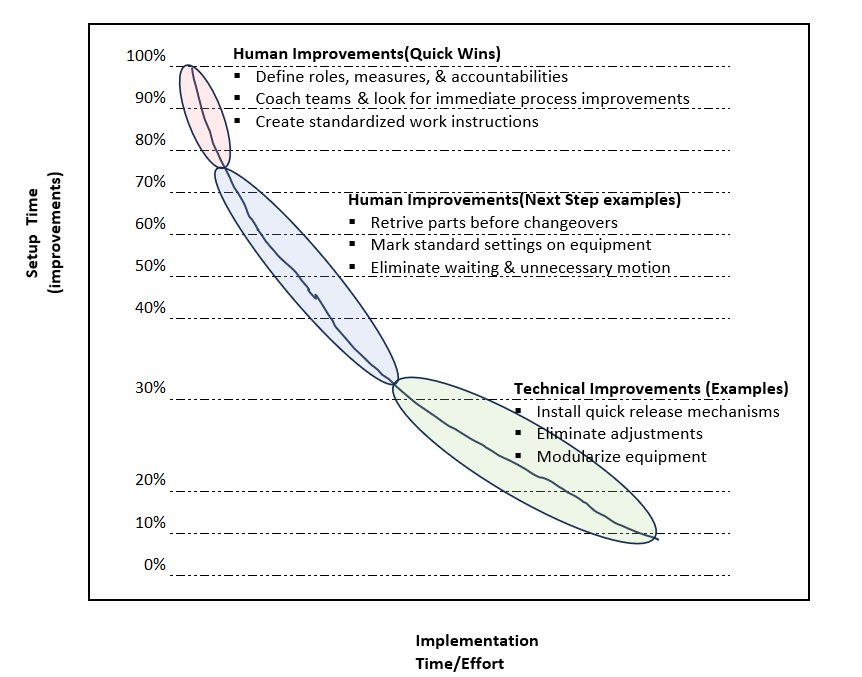
The information above helps us identify activities to focus on for immediate changeover time reduction. For example, retrieving or keeping necessary parts and tools available before changeovers can greatly reduce the time taken during these processes. This requires minimal effort, and we can expect immediate improvement.
Phases of changeover time reduction in SMED
If we prioritize the activities as mentioned in the above section, we can see the changeover time in different phases.
Please refer the picture below. We can see the initial reduction of changeover time, say 20% is easy and can be achieved with minimum effort.
And when we are trying reduce further from 80% the difficulty level increases. Difficult means we need to spend more time and cost.
This section emphasis the importance of prioritizing the activities for SMED implementation.

Tips in separating internal and external activities
We have the thumb rule to start any SMED implementation. By following these we will be able to organize of internal and external activities very well.
- Never start a changeover with an internal activity
- No external activities after the machine is shutdown
- No external activities between the internal activities
Along with the Thumb rule we can also use the most popular technique called ERCS to reduce the setup times in the machine.
Use ECRS for implementing SMED
ERCS stands for Eliminate Reduce Combine Simplify.
- Always try to eliminate the activity as much as possible.
- If that is not feasible, reduce the time taken to complete the activity.
- If that still doesn’t work, combine it with other activities.
- And when nothing else works, simply simplify the activity to reduce setup time.
Conclusion
This article will guide organizations on how to use data to identify the right machines for implementing SMED (Single-Minute Exchange of Die) and find potential bottlenecks in the system. It will also help create a clear roadmap for improving productivity and flexibility, based on market conditions and customer demand. The article includes practical tips and techniques, enabling SMED experts to focus on key areas that can quickly reduce setup times. Over time, this approach will encourage the adoption of advanced technologies, making the system stronger and more efficient.
In our upcoming article, we will cover the 7 key steps for SMED implementation, the documents needed to sustain SMED improvements, how to use a spaghetti diagram, and some additional helpful tips for successful SMED.
Now or Never
We’ve got your back on your manufacturing journey — Stay in touch
Follow us for step-by-step guidance, templates, and insights that save time and reduce mistakes.
Know Industrial Engineering Platform – Helping manufacturing industry professionals worldwide since 2019
Discover more from Know Industrial Engineering
Subscribe to get the latest posts sent to your email.

Thank you for sharing this article
great information