

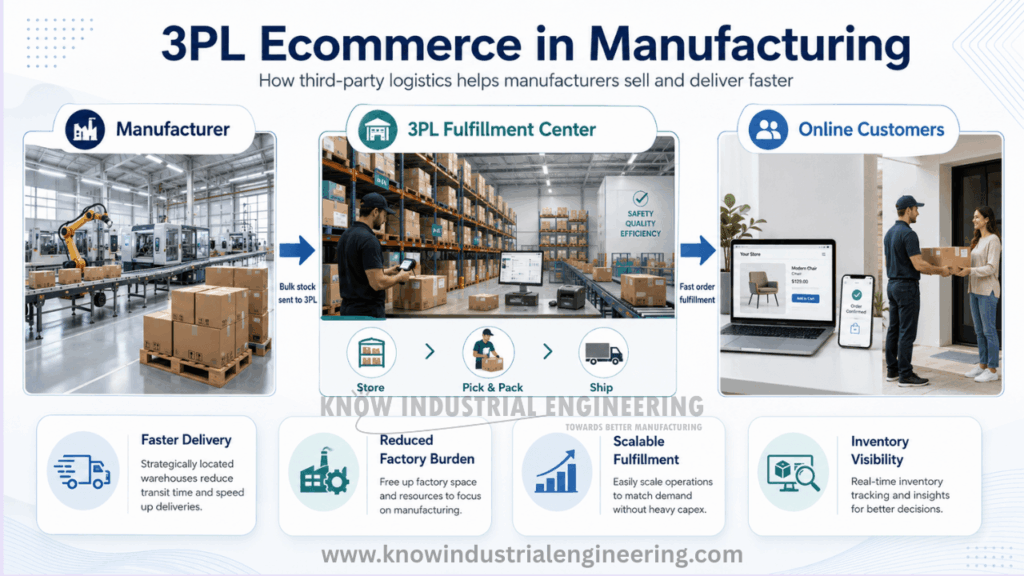

Manufacturing is no longer only about producing goods and sending them to distributors. Today, many manufacturers are also selling directly to customers, dealers, retailers, and online buyers through ecommerce platforms. This shift has created a new challenge: how can a manufacturer manage storage, order picking, packing, shipping, and returns without disturbing core production activities?
This is where 3PL ecommerce becomes important.
3PL ecommerce means using a third-party logistics provider to handle ecommerce fulfillment activities. Instead of the manufacturer managing every online order from its own factory or warehouse, a 3PL partner stores the finished goods, picks customer orders, packs them, ships them, and sometimes handles returns.
For manufacturing companies, this can reduce operational burden and improve delivery speed.
What is 3PL Ecommerce?
3PL stands for Third-Party Logistics. In ecommerce, it refers to an external logistics company that manages order fulfillment on behalf of a seller.
In simple terms, the manufacturer produces the product, and the 3PL partner takes care of the movement after production.
A 3PL ecommerce provider usually handles:
- Finished goods storage
- Inventory management
- Order picking
- Packing and labeling
- Shipping to customers
- Delivery tracking
- Returns handling
- Stock visibility reports
For example, a manufacturer producing industrial tools may sell products through its website, Amazon, or dealer portals. Instead of shipping each order from the factory, the company can send bulk stock to a 3PL warehouse. When online orders arrive, the 3PL company fulfills them directly.
Why 3PL Ecommerce Matters in Manufacturing
Manufacturing operations are designed mainly for production efficiency. Factories focus on machine utilization, manpower productivity, quality control, material flow, and production planning.
Ecommerce fulfillment is different. It deals with small orders, fast dispatch, accurate picking, customer-level packaging, and quick delivery.
A factory may be good at producing 10,000 units per month, but it may not be efficient at packing and shipping 500 individual online orders per day.
This is the gap where 3PL ecommerce becomes useful.
Traditional Manufacturing Supply Chain vs Ecommerce Fulfillment
In a traditional manufacturing supply chain, goods usually move like this:
Factory → Distributor → Dealer → Retailer → Customer
The manufacturer ships in bulk. The order quantity is usually large. Packaging is often designed for transport, not direct customer experience.
In ecommerce, the flow may look like this:
Factory → 3PL Warehouse → Customer
Here, the order size may be one piece, two pieces, or a small bundle. The customer expects fast delivery, proper packaging, tracking updates, and easy returns.
This requires a different operating model.
Benefits of 3PL Ecommerce for Manufacturers
1. Faster Delivery to Customers
A 3PL provider may have warehouses in multiple locations. Manufacturers can place stock closer to customers instead of shipping every order from one factory location.
This reduces delivery time and improves customer satisfaction.
2. Less Pressure on Factory Warehouse
Factory warehouses are often designed for raw materials, work-in-progress, and finished goods storage. Ecommerce fulfillment requires space for order sorting, packing tables, dispatch staging, courier handover, and return processing.
By using a 3PL partner, manufacturers can avoid overcrowding their factory warehouse.
3. Better Focus on Production
Manufacturers should focus on producing quality products at the right cost and right time. If the same team also manages ecommerce orders, dispatch follow-ups, and returns, production focus may suffer.
3PL helps separate production activities from fulfillment activities.
4. Scalable Operations
During seasonal demand, festival sales, product launches, or campaign periods, ecommerce orders may suddenly increase.
If the manufacturer handles everything internally, extra manpower, packing material, space, and dispatch coordination may be needed. A 3PL provider can usually scale these activities more easily.
5. Improved Inventory Visibility
Many 3PL providers offer software dashboards where manufacturers can see stock levels, order status, dispatch details, and returns.
This helps planning teams make better decisions on replenishment and production scheduling.
Example: How a Manufacturer Can Use 3PL Ecommerce
Let us take an example of a small appliance manufacturer.
The company produces 20,000 units per month. Earlier, it sold only through distributors. Now it starts selling directly through its ecommerce website.
Without 3PL, the factory must manage:
- Online order confirmation
- Picking from finished goods stock
- Packing individual orders
- Printing shipping labels
- Coordinating with courier partners
- Updating customers
- Managing returns
This can disturb the production and dispatch team.
With 3PL, the process becomes simpler:
- The manufacturer sends bulk finished goods to the 3PL warehouse.
- Online orders are automatically shared with the 3PL system.
- The 3PL team picks, packs, and ships each order.
- The manufacturer monitors stock and order status through reports.
- Replenishment is planned based on stock consumption.
This allows the manufacturer to sell online without building a full ecommerce logistics department immediately.
Key Areas Manufacturers Should Check Before Choosing a 3PL Partner
Choosing a 3PL partner should not be based only on price. Manufacturers must check operational capability.
Important points to evaluate:
1. Warehouse Location
The warehouse should be close to major customer regions or demand clusters. This reduces delivery time and shipping cost.
2. Inventory Accuracy
Stock mismatch can create serious problems in ecommerce. If the system shows stock available but the item is missing physically, orders may get delayed or cancelled.
Manufacturers should check how the 3PL manages cycle counting, barcode scanning, and stock reconciliation.
3. Order Processing Speed
For ecommerce, speed matters. The 3PL should be able to process orders within the agreed cut-off time.
For example, orders received before 2 PM may need to be dispatched on the same day.
4. Packaging Capability
Manufacturing packaging and ecommerce packaging are not always the same. Ecommerce needs safe, customer-friendly, courier-ready packaging.
The 3PL should understand product protection, labeling, branding, and damage prevention.
5. Return Handling
Returns are a major part of ecommerce. The 3PL should have a clear process for receiving returned goods, checking condition, updating stock, and separating damaged items.
6. System Integration
The 3PL system should connect with ecommerce platforms, ERP, inventory systems, or order management tools.
Manual order sharing through Excel can work in the beginning, but it may create errors as volume increases.
Challenges of 3PL Ecommerce in Manufacturing
Although 3PL ecommerce has many benefits, it also has challenges.
Loss of Direct Control
When stock is stored outside the factory, the manufacturer depends on the 3PL provider for accuracy, speed, and discipline.
Clear service-level agreements are necessary.
Additional Cost
3PL services involve storage charges, picking charges, packing charges, shipping charges, and sometimes return handling charges.
Manufacturers must compare this cost with the cost of managing fulfillment internally.
Data Dependency
If inventory data is not updated properly, production planning may be affected.
For example, the factory may think enough stock is available, but actual ecommerce stock may already be consumed.
Quality Risk During Handling
If the 3PL team does not handle products properly, damages may increase. This is especially important for fragile, electronic, precision, or high-value products.
Role of Industrial Engineering in 3PL Ecommerce
Industrial engineering plays an important role in designing efficient ecommerce fulfillment operations.
Industrial engineers can support in:
- Warehouse layout planning
- Storage location design
- Picking path optimization
- Manpower calculation
- Packing station design
- Time study for picking and packing
- Capacity planning
- Productivity measurement
- Cost per order calculation
- Bottleneck identification
- Standard operating procedure creation
For example, if a 3PL warehouse is dispatching 2,000 orders per day, industrial engineering methods can help calculate the required pickers, packers, scanners, staging space, and dispatch lanes.
This makes 3PL ecommerce not just a logistics topic, but also a manufacturing productivity topic.
When Should a Manufacturer Consider 3PL Ecommerce?
A manufacturer should consider 3PL ecommerce when:
- Online orders are increasing
- Factory dispatch team is overloaded
- Customers expect faster delivery
- Finished goods warehouse space is limited
- The company wants to sell in multiple regions
- Returns are becoming difficult to manage
- Ecommerce fulfillment is affecting production focus
- Order picking and packing errors are increasing
For small order volume, internal fulfillment may be manageable. But as ecommerce grows, 3PL can become a practical solution.
Conclusion
3PL ecommerce is becoming increasingly important for manufacturers who want to sell directly to customers and online markets. It helps manufacturers separate production from fulfillment, reduce delivery time, improve scalability, and focus better on core manufacturing activities.
However, 3PL should not be selected blindly. Manufacturers must evaluate warehouse location, inventory accuracy, order speed, packaging quality, return handling, system integration, and total cost.
For manufacturing companies, 3PL ecommerce is not just about outsourcing logistics. It is about building a faster, more flexible, and customer-focused supply chain.
As ecommerce continues to grow, manufacturers who combine strong production systems with efficient fulfillment networks will have a clear competitive advantage.
Now or Never
We’ve got your back on your manufacturing journey — Stay in touch
Follow us for step-by-step guidance, templates, and insights that save time and reduce mistakes.
Know Industrial Engineering Platform – Helping manufacturing industry professionals worldwide since 2019
Discover more from Know Industrial Engineering
Subscribe to get the latest posts sent to your email.