

Artificial intelligence is beginning to move beyond office applications, dashboards and cloud platforms. It is now entering machines, cameras, robots, production lines and inspection stations.
This development is known as Edge AI.
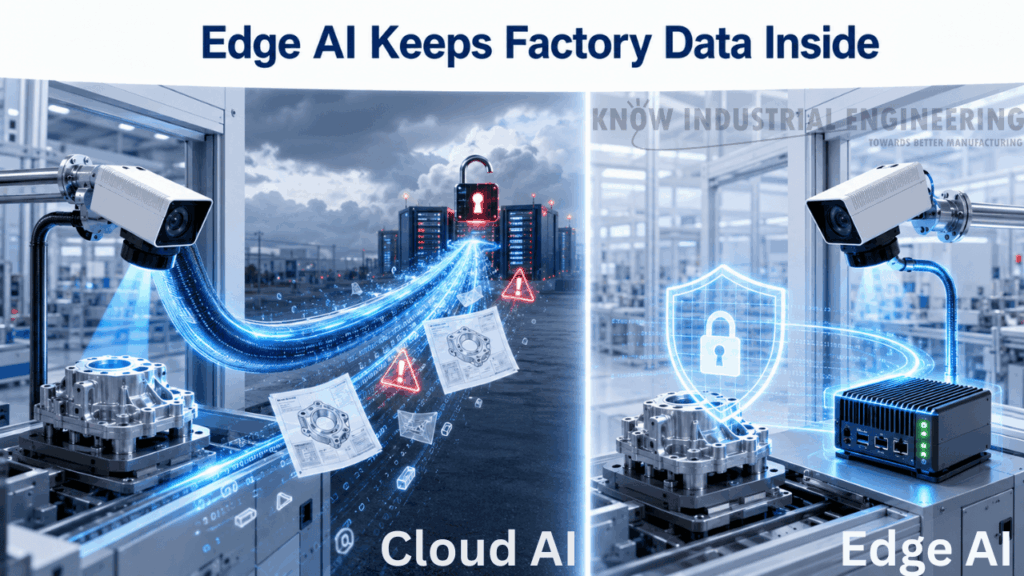
In a traditional cloud-based system, factory data is sent through the internet to a remote server for analysis. The result is then returned to the factory. Edge AI changes this arrangement by processing data close to where it is generated.
A camera can identify a defect without sending every image outside the factory. A vibration sensor can detect an abnormal machine condition locally. A robot can respond to its surroundings without waiting for instructions from a distant cloud server.
This ability to analyse information and make decisions near the production process is making Edge AI increasingly relevant to modern manufacturing.
What Is Edge AI in Manufacturing?
Edge AI in manufacturing is the use of artificial intelligence directly on or near factory machines, sensors, cameras, robots and production equipment.
The word “edge” refers to the edge of the computing network, where operational data is generated.
This may include:
- An industrial computer installed beside a machine
- A smart camera on an inspection station
- A local factory server
- An AI-enabled sensor
- A robot controller
- An edge gateway connected to a PLC
- A computer located inside the factory network
Instead of transferring every piece of production data to the cloud, the Edge AI system processes some or all of it locally.
NVIDIA describes Edge AI as AI computation performed close to where data is generated rather than exclusively in a central cloud or data centre. Intel’s industrial edge documentation similarly presents real-time, on-site AI processing as a way to detect manufacturing defects, process abnormalities and safety risks.
A Simple Edge AI Manufacturing Example
Consider a factory producing metal components.
After machining, every component passes through a visual inspection station. The inspection system must identify scratches, cracks, dimensional abnormalities and surface defects.
Inspection using cloud AI
In a cloud-based arrangement, the process may work like this:
- A camera captures the component image.
- The image is uploaded through the internet.
- A cloud-based AI model analyses the image.
- The result is returned to the factory.
- The system accepts or rejects the component.
This process can work, but it depends on network availability and communication speed. It may also require the factory to send a large number of production images outside its premises.
Inspection using Edge AI
With Edge AI, the process becomes:
- A camera captures the component image.
- A nearby industrial computer analyses it immediately.
- The AI model identifies whether a defect is present.
- The component is accepted or rejected.
- Only the inspection result or selected images are stored centrally.
The decision happens within the factory, close to the inspection point.
Intel documents industrial edge applications for real-time PCB anomaly detection, weld-porosity identification, pallet-condition inspection and worker safety monitoring using local video-processing systems.
How Does Edge AI Work?
An Edge AI system normally contains five main elements.
1. Data source
The process begins with a device that generates data.
Examples include:
- Camera
- Microphone
- Temperature sensor
- Vibration sensor
- Pressure sensor
- Torque sensor
- PLC
- Barcode scanner
- Robot
- Machine controller
2. Edge computing device
The data is received by a local computing device.
This could be:
- An industrial PC
- An embedded computer
- A smart camera
- An edge gateway
- A robot controller
- A local GPU-enabled server
The device must have sufficient computing capacity to run the required AI model.
3. Trained AI model
The system contains an AI or machine-learning model trained to recognise a pattern.
For example, the model may learn to identify:
- A defective weld
- An abnormal motor vibration
- Missing safety equipment
- Incorrect product assembly
- Tool wear
- Product orientation
- Unusual process behaviour
4. Local decision
The Edge AI device analyses the incoming data and produces a result.
Depending on the application, it may:
- Reject a defective product
- Stop a machine
- Generate a warning
- Alert the maintenance team
- Adjust an operating parameter
- Record an abnormal condition
- Guide an operator
5. Connection with factory systems
The Edge AI result may be connected to:
- Manufacturing Execution System
- Enterprise Resource Planning system
- Quality Management System
- Maintenance software
- Production dashboard
- PLC or SCADA system
- Local database
- Cloud analytics platform
Edge AI does not necessarily replace cloud computing. In many factories, local systems make immediate decisions while cloud or central systems perform model training, long-term analysis and comparison across multiple plants.
Microsoft describes this type of edge-to-cloud arrangement as a way to connect operational factory data with broader AI, analytics and manufacturing systems.
Edge AI vs Cloud AI in Manufacturing
Both Edge AI and cloud AI can be valuable. The correct choice depends on the application.
| Factor | Edge AI | Cloud AI |
|---|---|---|
| Processing location | Near the machine or process | Remote data centre or cloud platform |
| Response speed | Usually suitable for immediate decisions | May be affected by network delay |
| Internet dependency | Can often continue without internet | Usually requires reliable connectivity |
| Data privacy | Data can remain within the factory | Data may be transmitted externally |
| Computing capacity | Limited by local hardware | Can access large computing resources |
| Initial hardware | May require industrial edge devices | Local hardware requirement may be lower |
| Model training | Usually performed elsewhere | Suitable for large-scale model training |
| Real-time control | Strong suitability | Depends on connectivity and latency |
| Multi-factory comparison | More difficult locally | Easier through centralised data |
| Maintenance | Devices must be managed at each location | Central systems can be easier to update |
The practical answer is not always Edge AI or cloud AI.
For many manufacturers, the best approach is:
Edge AI for immediate operational decisions and cloud AI for deeper analysis, model development and multi-factory learning.
Example: Edge AI for Predictive Maintenance
Consider a motor operating on a critical production machine.
Vibration and temperature sensors continuously collect data. Under normal conditions, the vibration follows a predictable pattern.
Over time, a bearing begins to deteriorate. The vibration pattern changes slightly, even though the machine still appears to operate normally.
An Edge AI system can analyse this pattern locally and compare it with previously learned behaviour.
It may generate a warning such as:
Abnormal bearing behaviour detected. Inspect the drive-end bearing during the next planned stoppage.
The system does not need to wait for a complete breakdown.
Traditional maintenance approach
The machine may be maintained:
- After failure
- According to a fixed preventive-maintenance schedule
- When an operator notices unusual sound or heat
- After manually reviewing condition-monitoring data
Edge AI approach
The system continuously evaluates the equipment condition and highlights behaviour that differs from the expected pattern.
This does not mean that AI can accurately predict every breakdown. Sensor quality, historical data, machine conditions and model accuracy all affect the result.
The maintenance team must still verify the warning and decide the correct action.
Example: Edge AI for Tool-Wear Detection
Suppose a CNC machine uses a cutting tool to produce 1,000 components.
Traditionally, the factory may replace the tool after a fixed number of components, such as every 800 pieces.
This prevents unexpected failure, but the tool may still have usable life remaining.
Alternatively, the factory may continue using the tool until quality problems appear. This can lead to:
- Higher surface roughness
- Dimensional variation
- Rework
- Tool breakage
- Machine stoppage
- Rejected components
An Edge AI system can study signals such as:
- Spindle current
- Vibration
- Cutting force
- Acoustic data
- Temperature
- Surface image
The system can then estimate whether the tool condition is normal, deteriorating or critical.
This allows the factory to make a condition-based tool-change decision instead of depending entirely on a fixed quantity.
However, the AI recommendation should not be treated as automatically correct. Tool life may change with material hardness, cutting parameters, coolant condition and machine rigidity.
Applications of Edge AI in Manufacturing
Visual quality inspection
Edge AI cameras can inspect products for:
- Scratches
- Cracks
- Missing parts
- Wrong assembly
- Colour variation
- Surface defects
- Label errors
- Packaging damage
- Weld abnormalities
- PCB defects
The main advantage is that image analysis can happen near the inspection point.
Predictive maintenance
Machine-condition data can be analysed locally to identify abnormal behaviour before a major failure occurs.
Typical inputs include vibration, sound, current, temperature and pressure.
Operator safety monitoring
Edge AI vision systems can identify situations such as:
- Missing helmet
- Missing safety glasses
- Entry into a restricted zone
- Unsafe proximity to moving equipment
- Improper handling posture
- Blocked emergency exit
Such systems require careful implementation because employee monitoring can create privacy and trust concerns. Safety objectives, data retention, access permissions and employee communication must be clearly defined.
Product counting and classification
Edge AI can count products moving on a conveyor and distinguish between different models, sizes or categories.
This can help improve:
- Production reporting
- Packaging accuracy
- Inventory visibility
- Model-wise output tracking
- Reconciliation between planned and actual quantity
Assembly verification
A camera can check whether:
- All components are present
- Fasteners are installed
- Parts are in the correct orientation
- Wiring is connected correctly
- The correct variant is assembled
- The specified sequence has been followed
Process anomaly detection
AI can observe process signals and identify combinations that differ from normal production behaviour.
It may detect:
- Unusual pressure fluctuation
- Abnormal temperature pattern
- Unexpected cycle-time increase
- Irregular machine movement
- Excessive energy consumption
- Repeated micro-stoppages
Robot and autonomous vehicle navigation
Robots and autonomous mobile robots must respond quickly to objects, workers and changing factory conditions.
Processing environmental information locally can help them make immediate movement decisions without depending entirely on remote communication.
Energy monitoring
Edge AI can analyse equipment-level energy consumption and identify:
- Abnormal idle consumption
- Compressed-air leakage patterns
- High energy use during specific operations
- Machines operating without production
- Unusual peak-load behaviour
Why Edge AI Is Important for Manufacturing
Faster response
Some factory decisions cannot wait for data to travel to a remote server and return.
Examples include:
- Rejecting a defective component
- Stopping unsafe robot movement
- Detecting a worker near hazardous equipment
- Responding to an abnormal machine condition
- Correcting product orientation
Local processing can reduce dependence on network round trips.
Continued operation during internet failure
A factory should not lose essential inspection or safety capability merely because its internet connection is unavailable.
An Edge AI system can often continue operating locally, although cloud synchronisation may resume when connectivity is restored.
Data privacy
Production images, customer drawings, process parameters and machine information may be confidential.
Edge processing can allow sensitive data to remain within the factory while only necessary results are transmitted elsewhere.
However, Edge AI is not automatically secure. Local devices still require:
- Access control
- Network segmentation
- Encryption
- Software updates
- Device authentication
- Backup procedures
- Cybersecurity monitoring
Reduced data transfer
A high-speed inspection camera can generate a large amount of data.
Transmitting every image continuously may increase:
- Network load
- Cloud storage
- Communication cost
- Data-management complexity
An Edge AI device can process the images locally and transfer only:
- Inspection results
- Defect images
- Summary reports
- Model-performance data
- Selected production records
Real-time operational intelligence
Many traditional systems collect data for later reporting.
Edge AI can move the factory from:
“What happened yesterday?”
to:
“What is happening now, and does immediate action need to be taken?”
Edge AI Is Not the Same as Automation
A conventional automated system follows predefined logic.
For example:
If temperature exceeds 90°C, stop the machine.
This is rule-based automation.
An AI system may evaluate multiple signals together:
- Temperature trend
- Vibration pattern
- Motor current
- Production speed
- Historical failure behaviour
It may identify an abnormal condition even when none of the individual values has crossed a fixed limit.
Therefore:
- Automation follows programmed rules.
- Edge AI identifies patterns and makes predictions or classifications locally.
The two can work together. Edge AI can identify the situation, while the PLC or control system executes the approved response.
Edge AI Is Not the Same as IoT
The Internet of Things, or IoT, connects devices and allows them to collect and exchange data.
For example, an IoT sensor may send a motor’s temperature every minute.
Edge AI goes one step further by analysing the data near the device.
An easy distinction is:
- IoT collects and communicates data.
- Edge computing processes data locally.
- Edge AI uses an AI model to interpret the local data.
A system may use all three.
Challenges of Implementing Edge AI in a Factory
Edge AI should not be presented as a simple plug-and-play solution. Its performance depends on the surrounding manufacturing system.
Insufficient training data
An AI model needs relevant and representative data.
For a defect-inspection model, the factory may require images of:
- Acceptable products
- Different defect types
- Different lighting conditions
- Multiple product variants
- Borderline cases
- Natural production variation
A model trained on incomplete data may produce unreliable decisions.
False rejection
A good component may be classified as defective.
This creates:
- Unnecessary rejection
- Additional inspection
- Production delay
- Reduced trust in the system
False acceptance
A defective product may be classified as acceptable.
This is often the more serious risk because the defect may reach the customer.
Changing production conditions
AI performance can deteriorate when conditions change.
Examples include:
- New material
- Different supplier
- New product colour
- Camera movement
- Lighting change
- Tool change
- Machine modification
- Process-speed change
The model must be monitored and, when necessary, retrained.
Limited local computing resources
An edge device has less computing capacity than a large cloud platform.
The model may need to be simplified or optimised to run effectively on industrial hardware.
Device management
A factory with many Edge AI devices must manage:
- Model versions
- Software updates
- Cybersecurity patches
- Hardware condition
- User access
- Data retention
- Device failures
- Configuration changes
Integration with existing systems
The AI result must connect with actual factory processes.
A defect-detection model is not useful if:
- The rejection mechanism is unreliable
- Traceability is missing
- The quality team cannot review the result
- The operator does not know what action to take
- The system is not linked to the correct product variant
Lack of process clarity
AI cannot repair an undefined process.
Before introducing Edge AI, the factory should understand:
- What decision must be made?
- Who currently makes it?
- What information is used?
- What error is occurring?
- How frequently does it occur?
- What is the financial or operational impact?
- What action should follow the AI result?
How to Select an Edge AI Project
Factories should not begin by purchasing an AI device and then searching for a problem.
The correct sequence is:
Step 1: Identify a measurable factory problem
Examples:
- High inspection cost
- Repeated defect escape
- Unexpected machine failure
- Excessive tool replacement
- Safety-rule violation
- Inaccurate production counting
Step 2: Measure the current condition
Document:
- Present defect rate
- Inspection time
- Breakdown frequency
- Downtime
- Rework cost
- Rejection cost
- Labour hours
- Customer complaints
- Safety incidents
Step 3: Confirm that AI is necessary
Some problems can be solved more easily using:
- Fixture improvement
- Poka-yoke
- Sensor
- Limit switch
- Barcode
- PLC logic
- Standard work
- Preventive maintenance
- Better lighting
- Process redesign
AI should be used only when it adds meaningful capability.
Step 4: Define the required decision speed
Ask:
- Must the decision happen within milliseconds?
- Can it wait for several seconds?
- Can it be performed after the shift?
- Can internet interruption be tolerated?
The answer helps determine whether processing should happen at the edge, in the cloud or through a hybrid arrangement.
Step 5: Run a controlled pilot
Test the system on:
- One machine
- One product family
- One defect type
- One inspection point
- One clearly defined operating condition
Step 6: Validate the result
Measure:
- Detection accuracy
- False-rejection rate
- False-acceptance rate
- Response time
- Downtime reduction
- Labour reduction
- Rework reduction
- Customer-defect reduction
- System availability
Step 7: Calculate the financial impact
The project should be evaluated using actual savings and avoided costs.
Potential benefits include:
- Reduced inspection effort
- Reduced scrap
- Reduced rework
- Reduced breakdown loss
- Reduced customer complaints
- Avoided quality escapes
- Increased production availability
- Improved safety
Not every technical improvement becomes a direct financial saving. For example, saving inspection time creates financial value only when the released capacity is used, labour is genuinely reduced or an additional cost is avoided.
A Simple Edge AI ROI Example
A factory manually inspects 4,000 products per day.
Current inspection details:
- Two inspectors per shift
- Two shifts per day
- Annual employment cost per inspector: ₹480,000
- Four inspectors required in total
- Annual manual inspection cost: ₹1,920,000
After introducing an Edge AI inspection system:
- One inspector per shift is retained for verification
- Two inspectors are reassigned to other required work
- Annual Edge AI maintenance and support cost: ₹300,000
- Initial investment: ₹1,500,000
Potential annual operating benefit:
₹1,920,000 − ₹960,000 − ₹300,000
= ₹660,000 per year
Simple payback:
₹1,500,000 ÷ ₹660,000
= 2.27 years
However, this should not automatically be reported as labour-cost saving if the reassigned employees remain on the payroll and no other cost is avoided.
In that case, the benefit may initially be better described as:
- Released inspection capacity
- Avoided future recruitment
- Improved inspection consistency
- Potential reduction in defect escape
This distinction is important when presenting the project to management.
When Should a Factory Use Edge AI?
Edge AI is a strong candidate when:
- A decision must be made immediately
- Internet dependency is unacceptable
- Large volumes of sensor or image data are generated
- Sensitive production data should remain on-site
- The same analysis is repeatedly performed
- Human inspection is inconsistent
- Patterns are too complex for simple rules
- Local action must continue during connectivity failure
When May Edge AI Be Unnecessary?
Edge AI may not be the right solution when:
- A simple sensor can solve the problem
- The process is not standardised
- The factory has insufficient data
- The event occurs very rarely
- The financial impact is insignificant
- The decision does not require real-time processing
- The existing problem is caused by poor discipline or unclear ownership
- A basic poka-yoke can prevent the error
- The organisation cannot maintain the AI system
The most advanced solution is not always the best solution.
Will Edge AI Replace Factory Employees?
Edge AI is more likely to change tasks than eliminate every role connected with those tasks.
For example, a visual inspection system may reduce the need for continuous manual checking, but people may still be required to:
- Review uncertain cases
- Investigate defects
- Improve the process
- Maintain the system
- Verify model performance
- Manage product changes
- Approve corrective actions
The industrial engineer’s role may also expand.
Industrial engineers can help determine:
- Where Edge AI creates value
- How work content changes
- How much capacity is released
- Whether the improvement produces real savings
- How the new system affects cycle time
- What standard work must be revised
- How human and AI decisions should be divided
- Whether the technology improves the complete process
The KIE Perspective
Edge AI can give machines and production systems the ability to interpret factory data close to where the work happens.
Its value is not simply that AI runs on a small computer.
Its value comes from enabling a factory to make a useful decision:
- Before a defect moves to the next operation
- Before a bearing fails
- Before an unsafe situation becomes an accident
- Before excessive tool wear creates rework
- Before abnormal process behaviour affects production
However, installing AI beside a machine does not automatically create an intelligent factory.
The process must first be measurable. The data must be reliable. The required decision must be clearly defined. The response must be integrated with factory operations. The financial impact must also be evaluated honestly.
Edge AI should therefore be treated not merely as an IT project, but as a manufacturing-system improvement project involving production, quality, maintenance, industrial engineering, automation and cybersecurity.
The factories that benefit most will not necessarily be those that install the greatest number of AI devices.
They will be the factories that select the right problem, place intelligence at the right point and convert the AI result into timely operational action.
Frequently Asked Questions
What is Edge AI in simple words?
Edge AI means using artificial intelligence near the place where data is created, such as a machine, camera, robot or sensor, instead of depending entirely on a remote cloud server.
What is an example of Edge AI in manufacturing?
A camera that checks a product for defects using a nearby industrial computer is an example. The inspection decision is made inside the factory without uploading every image to the cloud.
Can Edge AI work without the internet?
Many Edge AI applications can continue operating without an active internet connection because the model and processing system are located locally. Some functions, such as central reporting or software updates, may still require connectivity.
Is Edge AI better than cloud AI?
Neither is universally better. Edge AI is usually more suitable for immediate, local and privacy-sensitive decisions. Cloud AI is often better for large-scale computing, model training, long-term analysis and comparison across multiple locations.
Is Edge AI the same as IoT?
No. IoT connects devices and transfers data. Edge AI analyses data locally using an AI model. The two technologies are often used together.
Does Edge AI require a GPU?
Not always. The required hardware depends on the complexity of the model, amount of data and required response time. Some applications can operate on CPUs or specialised AI accelerators, while advanced vision systems may require GPUs.
Can Edge AI be connected to a PLC?
Yes. An Edge AI system can exchange information with PLCs and other industrial systems through suitable communication protocols and integration layers. The AI may identify a condition, while the PLC performs the approved control action.
What are the main Edge AI applications in factories?
Common applications include quality inspection, predictive maintenance, tool-wear detection, operator safety monitoring, assembly verification, process anomaly detection, production counting and robot navigation.
Now or Never
We’ve got your back on your manufacturing journey — Stay in touch
Follow us for step-by-step guidance, templates, and insights that save time and reduce mistakes.
Know Industrial Engineering Platform – Helping manufacturing industry professionals worldwide since 2019
Discover more from Know Industrial Engineering
Subscribe to get the latest posts sent to your email.