


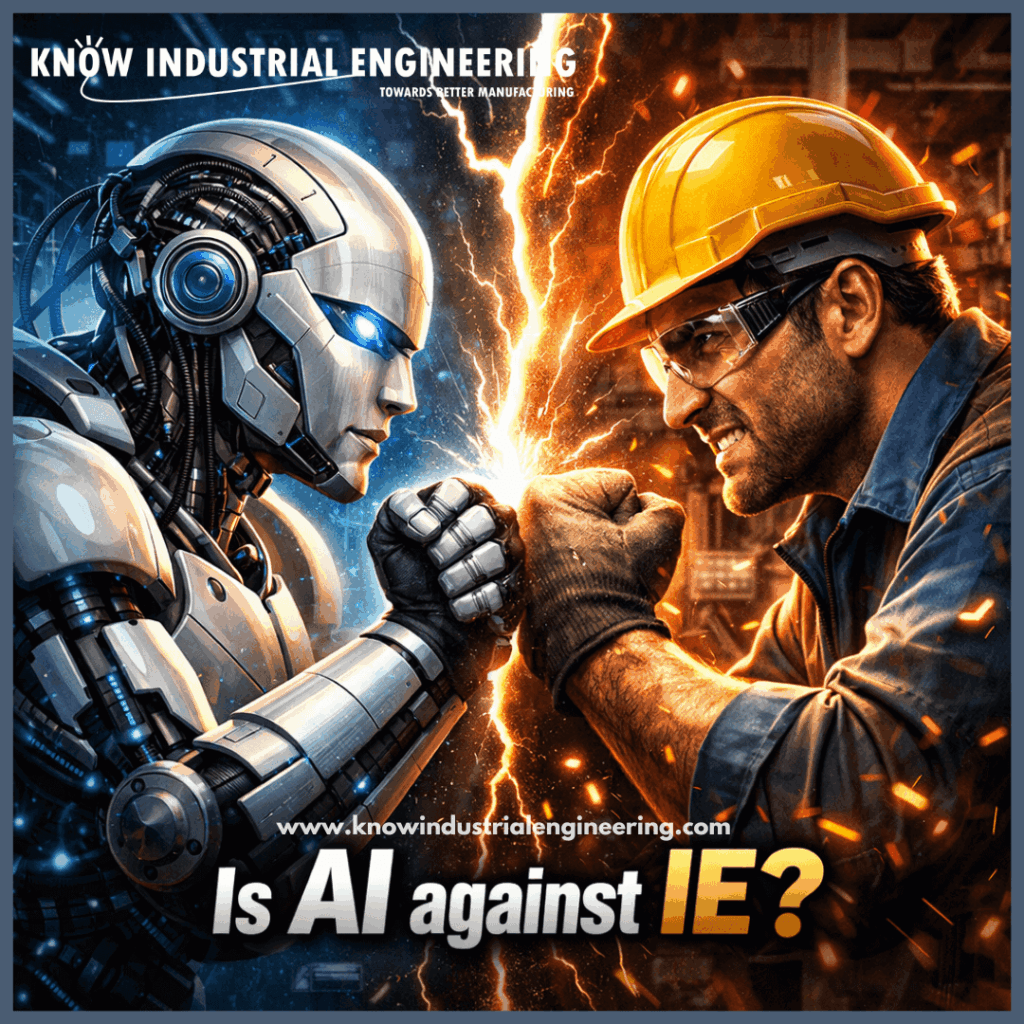
Let’s discuss about Artificial Intelligence and Industrial Engineering.
Over the past few years, I’ve noticed something interesting on the shopfloors….
It’s not loud.
It’s not flashy.
It’s not even obvious at first glance.
But you can feel it.
AI is slipping into industrial engineering, and not with a big announcement, but with small, almost unnoticed changes that build up over time.
One day you’re entering cycle time data manually, and the next day your dashboard is magically updated before you’ve even reached the plant.
And because these changes arrive slowly, many people don’t realize how fundamentally different our roles have started to become.
This is my observation on what I’ve seen happening.
1. AI is taking over the work nobody talks about, but everybody hates…
If there is one thing every industrial engineer shares worldwide, it’s the quiet frustration of repetitive work.
Data cleaning.
Copy-paste.
Excel fixing.
Chasing numbers.
Making reports at shift end.
Formatting presentations for meetings that last 10 minutes.
It’s the kind of work you never put in your resume, but it eats your entire day.
AI tools are slowly absorbing all of this. And honestly, it feels strange at first , almost like you forgot something because your workday suddenly became lighter.
But this “lightness” is not a bad thing.
It’s the space we once needed to think again.
2. Line balancing is becoming more honest
Earlier, line balancing was part data, part instinct.
We used to walk around with a stopwatch and a notebook, talk to operators, observe the flow, and mentally piece together what was happening.
But instinct can only see so much.
When AI analyzes thousands of cycle time recordings and highlights patterns humans would never notice, it’s humbling. Some tools can now show exactly why a line slows down at 3 PM every day or how two different shifts produce different outcomes despite “same” processes.
It doesn’t make engineers less important.. it just makes the work more transparent.
3. Time study is becoming more human than ever
This sounds ironic, but it’s true.
When AI-based video tools capture cycle times, operators relax.
No one is standing there with a stopwatch hovering awkwardly over their shoulder.
And the values feel less personal- more neutral.
I’ve seen operators trust AI results more than human-taken time studies, which is surprising if you think about how skeptical shopfloors usually are about new tech.
AI didn’t make time study cold.
It made it fair.
4. Predictive maintenance is changing the emotional climate of factories
If you’ve worked in manufacturing long enough, you know there’s a certain tension that comes with breakdowns. One unexpected failure can turn a calm into chaos in minutes.
Predictive maintenance doesn’t just improve uptimee- it changes the mood of the entire factory.
Suddenly:
nobody is running
nobody is shouting
nobody is scrambling for spares
nobody is explaining “why didn’t we foresee this?”
There’s a quiet confidence when you know the machine will tell you days in advance what it needs.
It feels… mature.
5. Quality is shifting from catching mistakes to understanding them
I’ve always believed that the real job of quality engineers is not to find defects, but to understand why they happen.
AI-based vision systems finally allow that.
They don’t miss scratches.
They don’t get tired on night shifts.
They don’t interpret “slightly dented” differently on different days.
And when these systems combine detection with data, they start showing deeper patterns- like which supplier is slowly slipping in consistency or which torque setting leads to long-term issues.
Quality is no longer about spotting defects.
It’s becoming about preventing disappointment.
6. Continuous improvement is actually becoming continuous
CI depends heavily on personal initiative.
If the engineer was motivated, improvement ideas came.
If not, everything stayed the same.
AI shifts this dynamic.
Now, anomalies appear as alerts.
Trends appear as suggestions.
Opportunities appear as automatic insights.
Engineers don’t start with a blank page- they start with clues.
CI becomes less about hunting for problems and more about choosing which one to solve first.
and It’s an entirely different mindset.
7. The biggest surprise? AI is making engineers more human, not less
I didn’t expect this….
When AI tools take away routine work, engineers rediscover the parts of the job that originally made them choose this career:
Talking to people
Understanding real constraints
Mentoring operators
Thinking about long-term solutions
Redesigning processes
Looking at the bigger picture
There is a renewed sense of meaning when your day isn’t wasted in spreadsheets.
AI didn’t steal the identity of industrial engineering.
It returned it!!
8. The engineers who will succeed are the ones who stay curious
You don’t need deep programming knowledge to survive in this era..
But you do need curiosity.
The willingness to explore a new tool.
The courage to question old habits.
The ability to mix intuition with data.
AI favors engineers who ask:
“Why is this happening?”
and then
“What else could we try?”
I’ve seen juniors outperform seniors simply because they were more open to combining experience with digital tools.
The industry is not selecting for experience alone anymore.
It’s selecting for learning speed.
Final thought: AI won’t replace Industrial engineers, but it will redefine what we’re valued for
In 2025, the factories that thrive are the ones where humans and AI complement each other.
AI handles the repetitive part.
Humans handle the meaningful part.
AI sees the pattern.
Engineers understand the story behind it.
AI suggests improvements.
Engineers make them real.
If we embrace this shift, industrial engineering is entering its most exciting era yet. If we resist it, we might miss the biggest transformation our field has seen in decades.
Either way, it’s happening.
And it’s already changing us….
Now or Never
We’ve got your back on your manufacturing journey — Stay in touch
Follow us for step-by-step guidance, templates, and insights that save time and reduce mistakes.
Know Industrial Engineering Platform – Helping manufacturing industry professionals worldwide since 2019
Discover more from Know Industrial Engineering
Subscribe to get the latest posts sent to your email.