

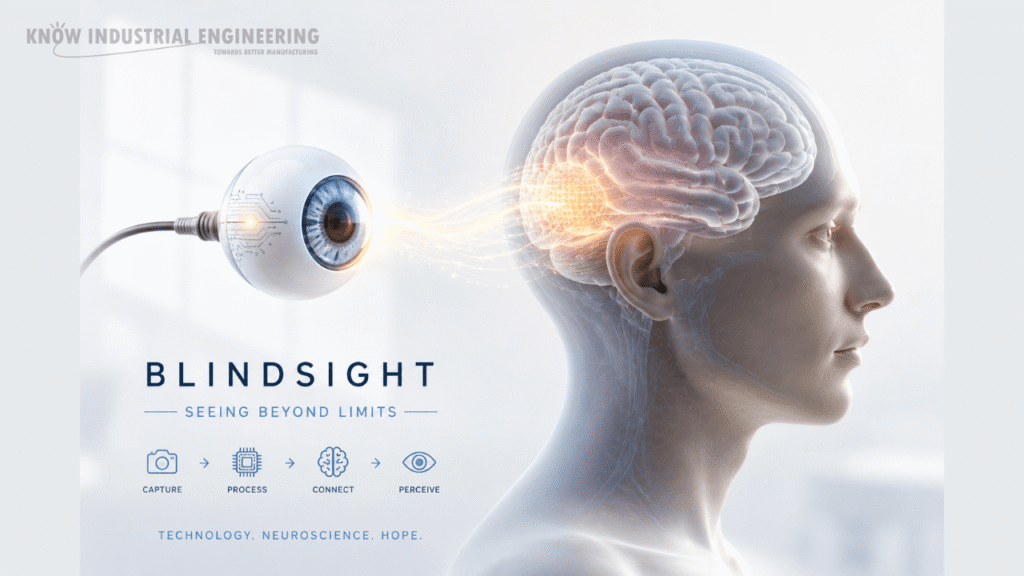
For most of human history, vision has followed one path: light enters the eyes, the eyes convert it into signals, and the brain interprets those signals.
Neuralink’s Blindsight is exploring a radically different possibility: What if visual information could reach the brain without depending on the eyes?
That idea makes Blindsight much more than a technology for restoring vision. If it succeeds and develops over time, it could become an early step toward a completely different relationship between humans, computers and machines.
What is Neuralink Blindsight?
Blindsight is a brain-computer interface being developed by Neuralink with the goal of creating artificial vision.
Instead of trying to repair a damaged eye, the concept is to bypass parts of the biological visual pathway and stimulate the brain’s visual cortex directly.
Think of the basic architecture like this:
Camera → Computer Processing → Brain Implant → Visual Cortex → Perceived Visual Information
A camera captures information from the environment. A computer processes that information and converts it into signals that can be delivered through implanted electrodes to areas of the brain responsible for vision.
The important point is that the brain effectively becomes part of the display system.
Will Someone Using Blindsight See Normally?
Not initially.
Artificial vision created through electrical stimulation of the visual cortex is expected to begin with relatively simple visual sensations rather than natural high-resolution eyesight.
A person might perceive points or patterns of light called phosphenes. By controlling many stimulation points and learning how the brain interprets them, researchers hope that increasingly useful visual information can eventually be produced.
The long-term challenge is enormous.
A camera can easily capture millions of pixels. The difficult part is understanding how to translate that information into electrical stimulation that the human brain can interpret meaningfully.
That is where neuroscience, electronics, AI and computing begin to converge.
Where Does Blindsight Stand Today?
Blindsight received the US FDA’s Breakthrough Device designation.
That is significant, but it should not be confused with full FDA approval or proof that the technology can already restore normal vision.
The designation is intended to help accelerate the development and regulatory interaction surrounding potentially important medical technologies.
Therefore, Blindsight should currently be understood as an experimental technology with extraordinary potential, rather than a commercially available solution for blindness.
The Bigger Idea Is Not Just Restoring Sight
This is where Blindsight becomes particularly interesting.
Today, a computer communicates visual information to us mainly through a physical display.
Your phone has a screen.
Your laptop has a screen.
A machine operator uses an HMI.
A control room uses monitors.
An engineer may use an AR or VR headset.
But imagine a future where certain information can be communicated directly to the brain’s visual system.
The technology would no longer simply be replacing damaged eyesight.
It could potentially create an entirely new information interface.
And that could eventually reach manufacturing.
What Could This Mean for Manufacturing?
Imagine a maintenance technician looking at a machine and immediately perceiving:
Bearing temperature: 86°C
Vibration abnormal
Motor 2 requires inspection
There may be no handheld device and, eventually, perhaps no conventional display.
A production supervisor walking through a factory could potentially receive visual indicators showing which machines are behind schedule, where WIP is accumulating or which workstation has a quality problem.
A warehouse operator could potentially perceive navigation instructions and the correct picking location while moving through the warehouse.
An assembly operator could receive step-by-step work instructions directly within their perceived visual environment.
Quality inspectors could be assisted by AI systems that identify possible defects and communicate their locations visually.
Maintenance engineers could receive information from digital twins, sensors and predictive-maintenance systems while physically examining equipment.
The information chain could eventually become:
Factory Sensors → AI → Brain-Computer Interface → Human
And communication could potentially move in the opposite direction as brain-computer interfaces advance:
Human Intention → Brain-Computer Interface → Machine
That would represent a very different form of Human-Machine Interface (HMI).
From HMI to Human-Machine Integration
Manufacturing has continuously changed the way humans communicate with machines.
Mechanical controls gave way to electrical panels.
Electrical panels evolved into PLCs and HMIs.
Computers introduced dashboards and MES systems.
Mobile devices brought factory information into our hands.
AR and VR are beginning to place digital information within our field of view.
Brain-computer interfaces could eventually take another step: bringing information closer to the point where humans actually perceive and act on it.
Blindsight itself is being developed for a medical purpose, and industrial applications remain speculative and likely far away.
But the underlying technological direction is worth watching.
The factory of the future may not simply contain smarter machines.
The interface between the human and the factory itself may change.
Now or Never
We’ve got your back on your manufacturing journey — Stay in touch
Follow us for step-by-step guidance, templates, and insights that save time and reduce mistakes.
Know Industrial Engineering Platform – Helping manufacturing industry professionals worldwide since 2019
Discover more from Know Industrial Engineering
Subscribe to get the latest posts sent to your email.