Joshna Joy

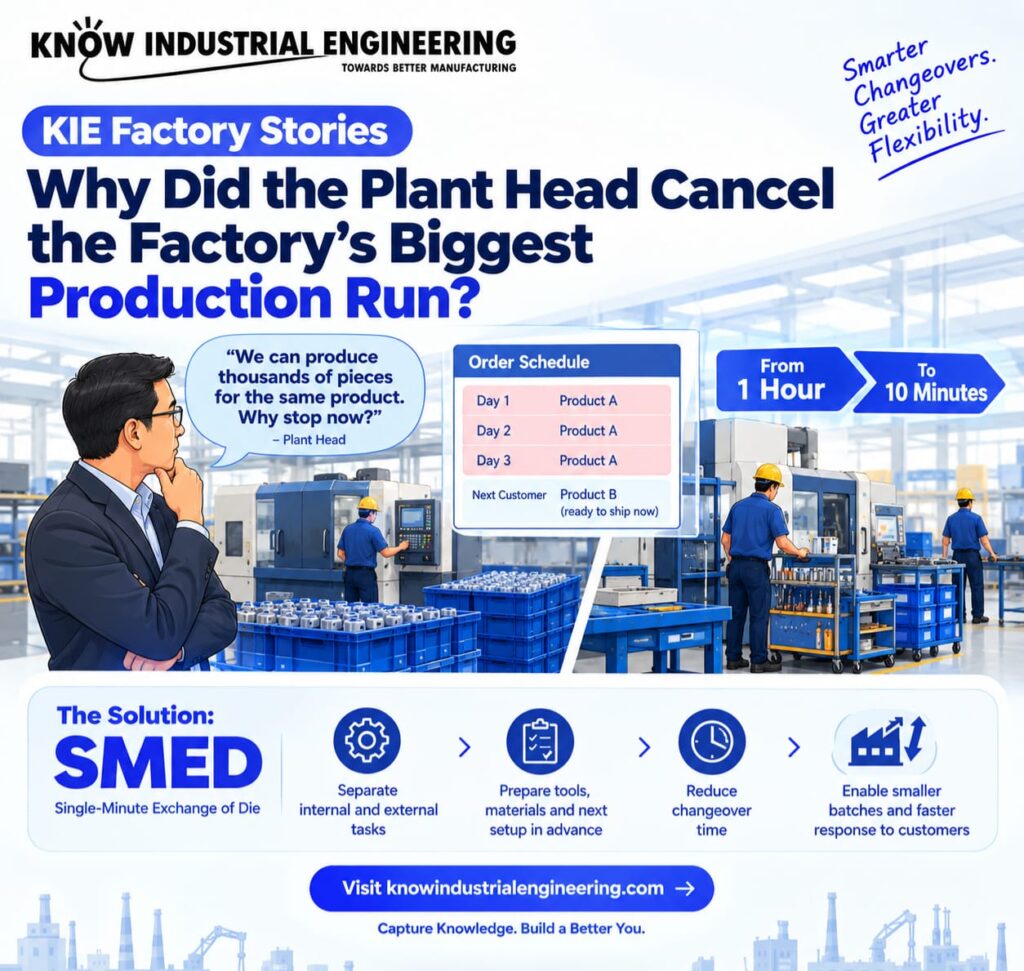
KIE Factory Stories: Why Did the Plant Head Cancel the Factory’s Biggest Production Run?

“We have enough orders to keep this machine running for three days. Why are we stopping?” The Production Manager couldn’t believe the decision. The machine was ready. Materials were available. Operators were assigned. But the Plant Head had just cancelled the production run. He had noticed something in the order schedule. All three days of […]

KIE Factory Stories: Why Did the Plant Head Cancel the Factory’s Biggest Production Run? Read More »

Overall Labour Productivity in Manufacturing:Measuring Output Per Worker

What Is Labour Productivity? Labour productivity measures how much output is produced using a given amount of labour. In manufacturing, it helps industrial engineers understand whether manpower is being utilized effectively and identify opportunities to improve production without unnecessarily increasing headcount. Labour Productivity Formula Labour Productivity = Total Output ÷ Total Labour Hours Output can

Overall Labour Productivity in Manufacturing:Measuring Output Per Worker Read More »

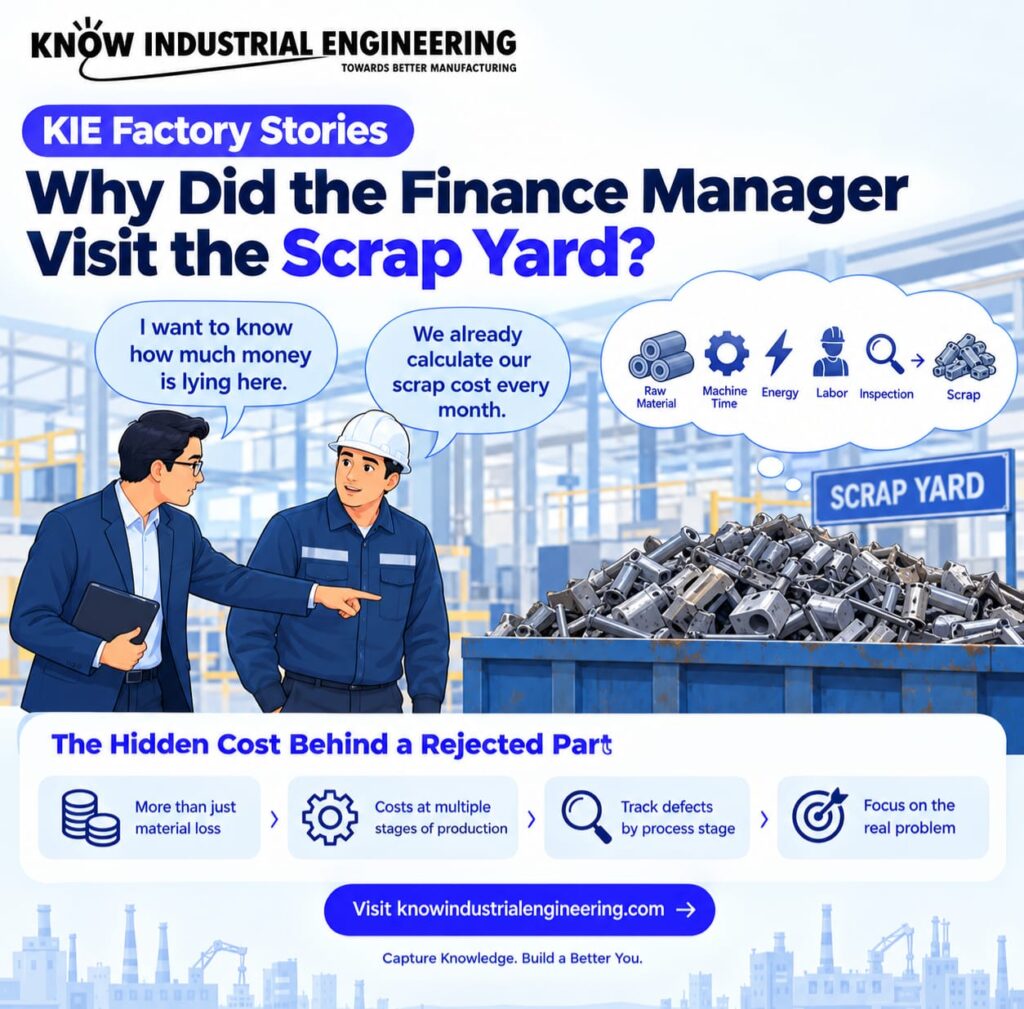
KIE Factory Stories: Why Did the Finance Manager Visit the Scrap Yard?

The Production Manager was surprised to see him there. “What are you doing here? Looking for something?” The Finance Manager pointed at a pile of rejected metal parts. “I want to know how much money is lying here.” The Production Manager smiled. “We already calculate our scrap cost every month.” “Do we calculate what happens

KIE Factory Stories: Why Did the Finance Manager Visit the Scrap Yard? Read More »

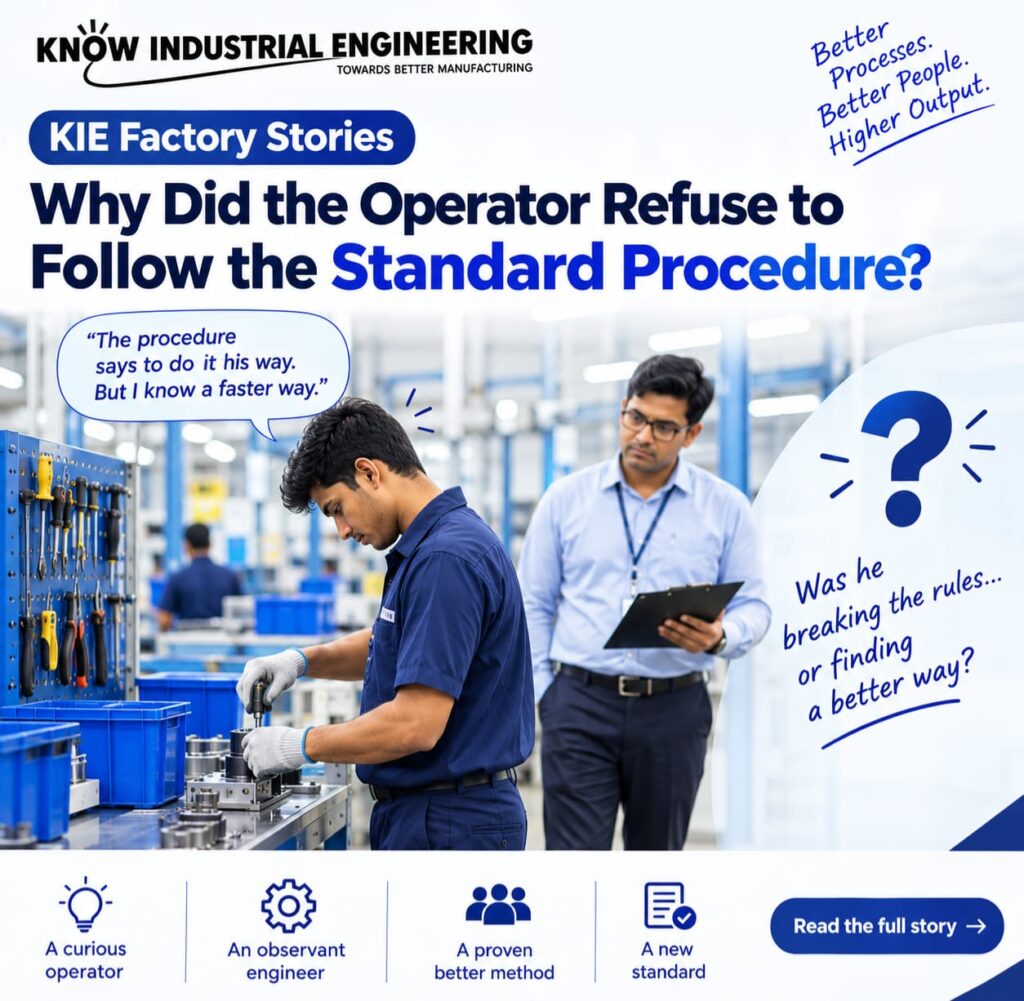
KIE Factory Stories: Why Did the Operator Refuse to Follow the Standard Procedure?

“The procedure says to do it this way. But I know a faster way.” The supervisor was ready to issue a warning. The operator had been using a different method for months. And surprisingly, he was producing more parts than anyone else on the shift. The Industrial Engineer decided to watch him work. The difference

KIE Factory Stories: Why Did the Operator Refuse to Follow the Standard Procedure? Read More »

What is A3 Problem Solving?

A3 Problem Solving is a structured approach to understanding problems, identifying root causes, developing countermeasures, and monitoring results. It presents the entire problem-solving process on a single A3-sized sheet of paper, encouraging teams to focus on facts, logic, and clear communication. In simple terms Instead of creating a long report about low production output, an

What is A3 Problem Solving? Read More »

KIE Factory Stories: Why Did the Plant Head Reject a ₹20 Lakh Cost-Saving Proposal?

“We can save ₹20 lakh every year.” The Finance Manager was impressed. The engineering team had proposed removing a small inspection step from the production process. It would reduce labor costs, shorten cycle time and increase output. The numbers looked excellent. But the Plant Head asked one question. “What happens if we stop this inspection?”

KIE Factory Stories: Why Did the Plant Head Reject a ₹20 Lakh Cost-Saving Proposal? Read More »

What is 8D Problem Solving and How Does It Help Manufacturing Quality?

What is 8D Problem Solving? 8D (Eight Disciplines) is a structured problem-solving method used to investigate recurring quality issues, identify root causes, and implement corrective actions that prevent recurrence. It encourages teams to solve problems using evidence rather than assumptions. In simple terms Imagine a customer repeatedly receives defective components from your factory. Instead of

What is 8D Problem Solving and How Does It Help Manufacturing Quality? Read More »

What is Gauge R&R and Why Is It Important in Quality Control?

What is Gauge R&R? Gauge Repeatability and Reproducibility (Gauge R&R) is a measurement system analysis method used to determine how much variation comes from the measurement system rather than the parts being measured. It evaluates two important sources of variation: In simple terms Imagine three quality inspectors measuring the diameter of the same metal component.

What is Gauge R&R and Why Is It Important in Quality Control? Read More »

KIE Factory Stories: Why Did the AI System Approve a Defective Part?

“The new vision system has approved all 500 parts.” The Quality Manager looked relieved. The factory had installed an AI-powered camera to detect surface defects. It was faster than manual inspection and never complained about repetitive work. But a customer returned a part with a clear scratch. The Quality Manager checked the inspection records. The

KIE Factory Stories: Why Did the AI System Approve a Defective Part? Read More »

Trainings