KIE Factory Stories: Why Did the Operator Refuse to Use the New Automated System?

“The new system is ready. Why are you still maintaining the old records?” The Production Manager was frustrated. The factory had invested in a digital production monitoring system. Machine data was collected automatically. Production reports were generated in seconds. But one experienced operator continued maintaining his handwritten production notebook. The manager asked him to stop.

KIE Factory Stories: Why Did the Operator Refuse to Use the New Automated System? Read More »

What is Economic Order Quantity (EOQ) and How Does It Reduce Inventory Costs?

What is Economic Order Quantity? Economic Order Quantity (EOQ) is an inventory management method used to calculate the most economical quantity of material to order at one time. It balances two important costs: In simple terms Ordering materials in very small quantities means placing purchase orders frequently. Ordering in very large quantities means keeping more

What is Economic Order Quantity (EOQ) and How Does It Reduce Inventory Costs? Read More »

KIE Factory Stories: Why Did the Factory Reject an Order It Had Already Won?

The Sales Manager walked into the Plant Head’s office with exciting news. “We have received an order for 5,000 additional units. The customer wants delivery within two weeks.” The Production Manager immediately started calculating machine capacity. “We can manage it with overtime.” The Sales Manager smiled. But the Plant Head asked one question. “Have we

KIE Factory Stories: Why Did the Factory Reject an Order It Had Already Won? Read More »

What is a Master Production Schedule (MPS) and Why Is It Important?

What is a Master Production Schedule? A Master Production Schedule (MPS) is a detailed plan that specifies which finished products must be manufactured, in what quantities, and during which time periods. It converts customer demand and business requirements into a planned production schedule. In simple terms Imagine an electronics factory receives orders for three products:

What is a Master Production Schedule (MPS) and Why Is It Important? Read More »

KIE Factory Stories: Why Did the Experienced Operator Make the Same Mistake Every Monday?

“Again? This is the third Monday in a row!” The Quality Engineer was frustrated. Every Monday morning, the first batch from one assembly station had the same defect. By Tuesday, the problem disappeared. The team had already retrained the operator. They had displayed warning notices. They had even introduced an additional inspection. Nothing changed. The

KIE Factory Stories: Why Did the Experienced Operator Make the Same Mistake Every Monday? Read More »

What is Material Requirements Planning (MRP) and How Does It Work?

What is Material Requirements Planning? Material Requirements Planning (MRP) is a production planning system used to calculate what materials are required, how much is needed, and when they should be available to meet the production schedule. It helps manufacturers coordinate purchasing, inventory, and production activities. In simple terms A factory receives an order for 200

What is Material Requirements Planning (MRP) and How Does It Work? Read More »

KIE Factory Stories: Why Did the Customer Pay for a Product That the Factory Never Made?

The Finance Manager was reviewing the monthly production report when he noticed something unusual. The factory had purchased enough raw material for 10,000 units. But only 9,200 units had been shipped. “Where are the remaining 800 units?” he asked. The Production Manager checked the records. There were no major quality issues. No unusual machine breakdowns.

KIE Factory Stories: Why Did the Customer Pay for a Product That the Factory Never Made? Read More »

What is a Bill of Materials (BOM) and Why Is It Important in Manufacturing?

What is a Bill of Materials? A Bill of Materials (BOM) is a structured list of all the raw materials, components, subassemblies, and quantities required to manufacture a product. It acts as a product’s ingredient list, helping production, purchasing, stores, and planning teams understand exactly what is needed. In simple terms To manufacture one electrical

What is a Bill of Materials (BOM) and Why Is It Important in Manufacturing? Read More »

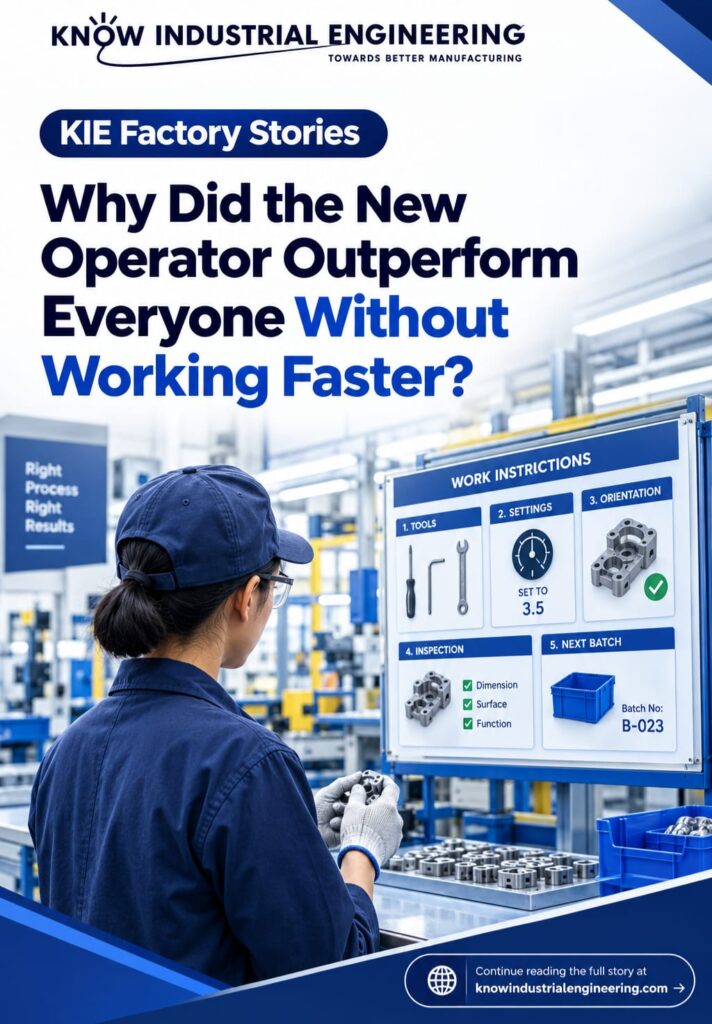
KIE Factory Stories: Why Did the New Operator Outperform Everyone Without Working Faster?

The production supervisor was checking the output board when he noticed something unusual. The newest operator had completed almost as many parts as the factory’s most experienced worker. “How are you doing that?” he asked. The new operator looked confused. “I’m just following the instructions.” The supervisor watched him work. His movements were ordinary. His

KIE Factory Stories: Why Did the New Operator Outperform Everyone Without Working Faster? Read More »

What is a Reorder Point and How Does It Prevent Material Shortages?

What is a Reorder Point? The Reorder Point (ROP) is the inventory level at which a company should trigger a replenishment order to avoid running out of material before new stock arrives. It helps purchasing and production teams decide when to reorder, rather than waiting until inventory is nearly exhausted. In simple terms If a

What is a Reorder Point and How Does It Prevent Material Shortages? Read More »

Trainings