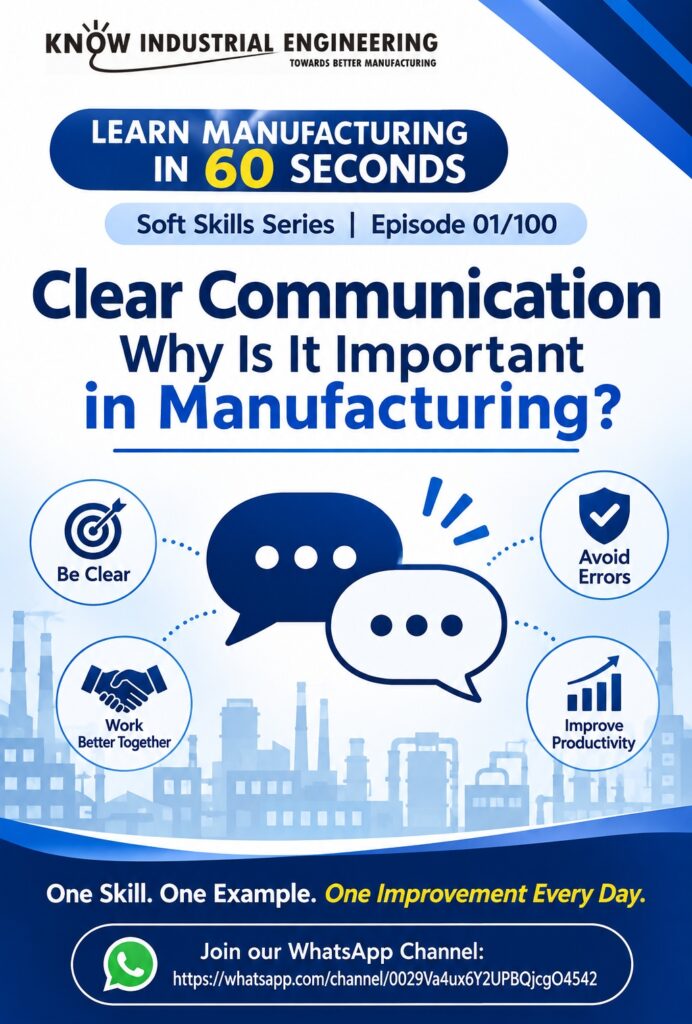
Manufacturing Topics in 60 s

Soft Skills Series : Clear Communication

What is Clear Communication? Clear communication means sharing information in a simple, accurate, and understandable manner. In manufacturing, effective communication helps prevent misunderstandings, reduce errors, and ensure smooth coordination between departments. Example from a Factory A production supervisor needs to communicate a daily production target to an operator. Poor Response: “Increase production. We need more

Soft Skills Series : Clear Communication Read More »

KIE Factory Stories: Why Did the Operator Refuse a Promotion?

“We want to make you a line supervisor.” The Production Manager was surprised by the answer. “No, sir. I would prefer to remain an operator.” The operator had 12 years of experience. He was highly skilled, respected by his colleagues and consistently delivered excellent results. The manager couldn’t understand his decision. “Don’t you want career

KIE Factory Stories: Why Did the Operator Refuse a Promotion? Read More »

Histogram: Understand the Distribution of Quality Data

What is a Histogram? A Histogram is a graphical tool used to show how frequently different values occur within a set of data. In manufacturing, it helps engineers understand process variation and identify whether production measurements are consistent or widely spread. Simple Factory Example A quality inspector measures the diameter of 50 manufactured metal components.

Histogram: Understand the Distribution of Quality Data Read More »

Check Sheet: A Simple Tool for Collecting Quality Data in Manufacturing

What is a Check Sheet? A Check Sheet is a structured form used to collect and record data systematically. In manufacturing, it helps operators and quality inspectors track defects, production issues, machine stoppages, and other recurring problems. Simple Factory Example Imagine a quality inspector checks 100 finished products and identifies these defects: Instead of recording

Check Sheet: A Simple Tool for Collecting Quality Data in Manufacturing Read More »

Inventory Turnover Ratio: Measure How Efficiently a Factory Uses Its Inventory

What is Inventory Turnover Ratio? Inventory Turnover Ratio measures how many times a company sells or uses its inventory during a specific period. It helps manufacturers understand whether materials and finished goods are moving efficiently or remaining in stock for too long. Formula Inventory Turnover Ratio = Cost of Goods Sold (COGS) ÷ Average Inventory

Inventory Turnover Ratio: Measure How Efficiently a Factory Uses Its Inventory Read More »

ABC Analysis: How to Prioritize Inventory in a Factory

What is ABC Analysis? ABC Analysis is an inventory management technique that classifies materials based on their annual consumption value. It helps factories identify which materials need more attention and tighter control. The Three Categories A – High-value items B – Medium-value items C – Low-value items Simple Example A factory uses three raw materials:

ABC Analysis: How to Prioritize Inventory in a Factory Read More »

What is Economic Order Quantity (EOQ) and How Does It Reduce Inventory Costs?

What is Economic Order Quantity? Economic Order Quantity (EOQ) is an inventory management method used to calculate the most economical quantity of material to order at one time. It balances two important costs: In simple terms Ordering materials in very small quantities means placing purchase orders frequently. Ordering in very large quantities means keeping more

What is Economic Order Quantity (EOQ) and How Does It Reduce Inventory Costs? Read More »

What is a Master Production Schedule (MPS) and Why Is It Important?

What is a Master Production Schedule? A Master Production Schedule (MPS) is a detailed plan that specifies which finished products must be manufactured, in what quantities, and during which time periods. It converts customer demand and business requirements into a planned production schedule. In simple terms Imagine an electronics factory receives orders for three products:

What is a Master Production Schedule (MPS) and Why Is It Important? Read More »

What is Material Requirements Planning (MRP) and How Does It Work?

What is Material Requirements Planning? Material Requirements Planning (MRP) is a production planning system used to calculate what materials are required, how much is needed, and when they should be available to meet the production schedule. It helps manufacturers coordinate purchasing, inventory, and production activities. In simple terms A factory receives an order for 200

What is Material Requirements Planning (MRP) and How Does It Work? Read More »

What is a Bill of Materials (BOM) and Why Is It Important in Manufacturing?

What is a Bill of Materials? A Bill of Materials (BOM) is a structured list of all the raw materials, components, subassemblies, and quantities required to manufacture a product. It acts as a product’s ingredient list, helping production, purchasing, stores, and planning teams understand exactly what is needed. In simple terms To manufacture one electrical

What is a Bill of Materials (BOM) and Why Is It Important in Manufacturing? Read More »

Trainings