

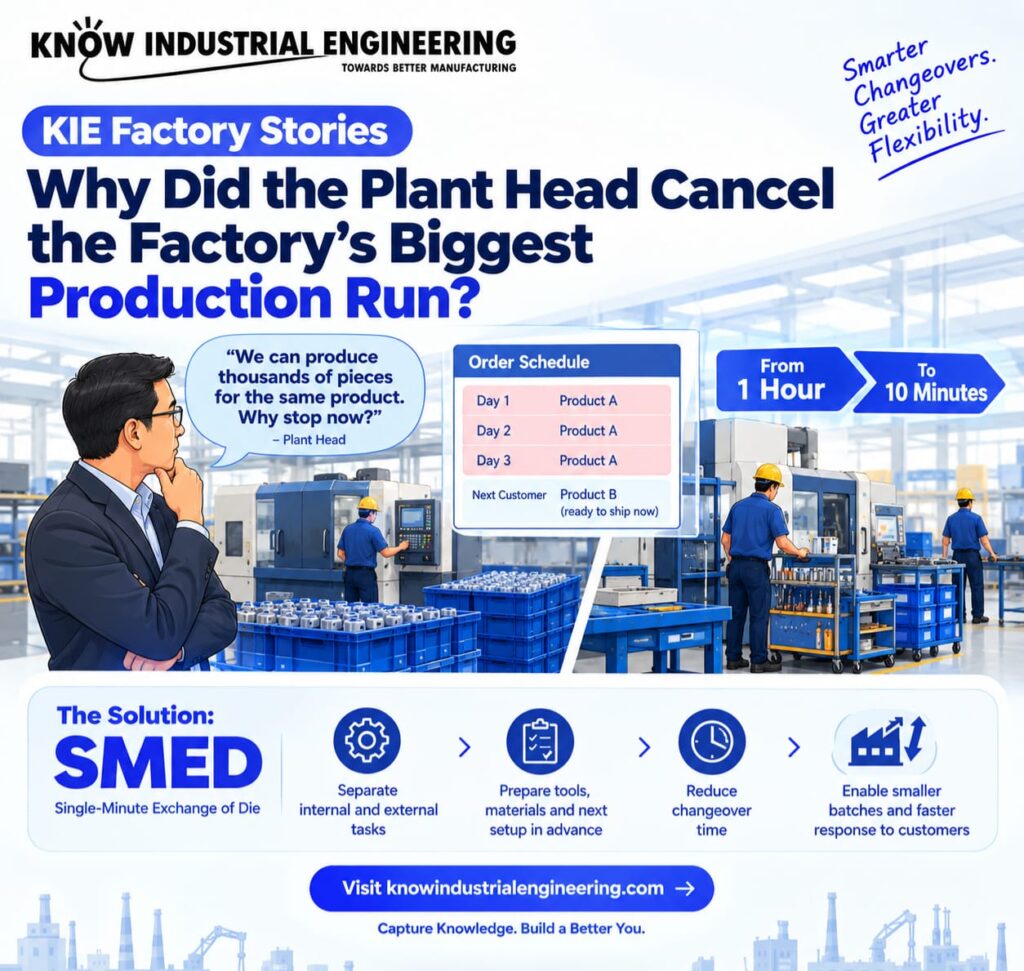
“We have enough orders to keep this machine running for three days. Why are we stopping?”
The Production Manager couldn’t believe the decision.
The machine was ready. Materials were available. Operators were assigned.
But the Plant Head had just cancelled the production run.
He had noticed something in the order schedule.
All three days of production were for the same product.
The factory would produce thousands of pieces, even though the next customer delivery was still weeks away.
Meanwhile, another customer was waiting for a different product that could be shipped immediately.
The Production Manager explained that changing products took nearly an hour.
“So we make a huge batch to avoid losing that hour,” he said.
The Plant Head asked a different question.
“How much time could we save if the changeover took ten minutes instead?”
The engineering team investigated.
They separated the tasks that required the machine to be stopped from those that could be prepared in advance.
They arranged tools, checked materials and prepared the next setup while the machine was still running.
After several trials, changeover time dropped significantly.
Now the factory could produce smaller batches without losing so much production time.
Customer orders moved faster, and less inventory sat waiting for delivery.
This is the thinking behind SMED — Single-Minute Exchange of Die.
The goal is to reduce changeover time so factories can switch products quickly and produce smaller batches more economically.
A long changeover encourages big batches.
A short changeover gives the factory the freedom to respond
Now or Never
We’ve got your back on your manufacturing journey — Stay in touch
Follow us for step-by-step guidance, templates, and insights that save time and reduce mistakes.
Know Industrial Engineering Platform – Helping manufacturing industry professionals worldwide since 2019
Discover more from Know Industrial Engineering
Subscribe to get the latest posts sent to your email.