

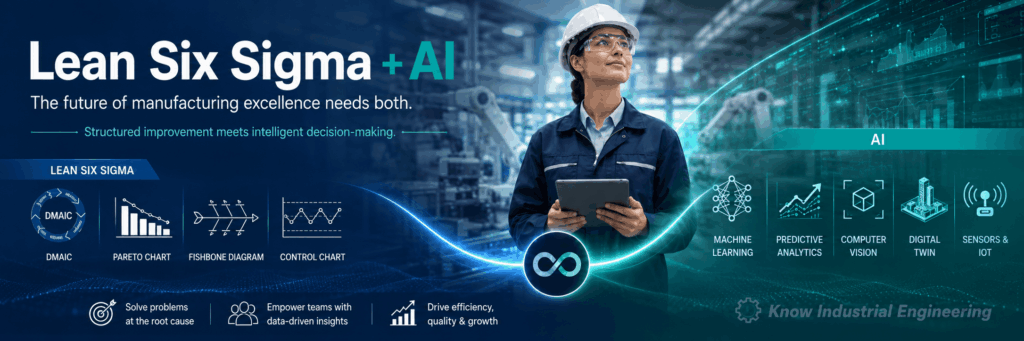

Walk into any manufacturing plant today and you will find two parallel conversations happening, related to AI and Lean six sigma.
The first is familiar. Teams are discussing scrap reduction, line balancing, cycle time improvements, OEE losses, and corrective actions. Whiteboards are filled with Pareto charts, fishbone diagrams, and action trackers. Lean Six Sigma continues to be the language of operational excellence.
The second conversation is newer. It revolves around machine learning models, digital twins, predictive maintenance, computer vision, and generative AI.
For many organizations, these seem like separate worlds.
They are not.
In fact, some of the most interesting transformations in manufacturing are happening where these two disciplines intersect. The question is no longer whether Artificial Intelligence will enter operational excellence. It already has. The more important question is whether Lean Six Sigma professionals are prepared to use it effectively. After all, the fundamental objective has not changed. Factories still need to reduce defects, improve productivity, optimize resources, and deliver value to customers. What has changed is the volume of data available and the speed at which decisions are expected to be made.
A Black Belt leading a process improvement project fifteen years ago might have spent weeks collecting production data. Today, a single assembly line can generate more information in one shift than many factories generated in a month. The challenge has shifted from data collection to data interpretation. This is where AI starts becoming more than just another technology buzzword.
How AI helps Lean Six Sigma
| Lean Six Sigma Step | How AI Helps in That Step |
|---|---|
| Define | AI helps identify the right problem by analyzing customer complaints, production reports, defect trends, downtime records, and quality feedback. It can highlight recurring issues and help teams select high-impact improvement projects. |
| Measure | AI can collect, clean, and organize large volumes of production data from machines, sensors, inspection systems, ERP reports, and operator inputs. This improves data accuracy and reduces manual effort in measurement. |
| Analyze | AI is highly useful in finding hidden patterns, correlations, and possible root causes. It can detect relationships between machine settings, material batches, operator variation, environmental conditions, and defect occurrence. |
| Improve | AI can simulate different improvement options before implementation. It can suggest optimized machine parameters, better production schedules, improved line balancing options, and resource utilization improvements. |
| Control | AI supports real-time monitoring through dashboards, alerts, anomaly detection, and predictive models. It helps ensure that the improved process remains stable and prevents the same problem from returning. |
The Real Limitation of Traditional DMAIC
Lean Six Sigma has always been built around structured problem-solving. The DMAIC framework remains one of the most powerful approaches for tackling operational challenges. However, anyone who has led improvement projects knows where most of the effort goes.
Not in creating solutions.
Not in implementing improvements.
But in finding the actual root cause.
Teams spend weeks validating data, debating correlations, conducting studies, and eliminating assumptions. Sometimes the root cause is obvious. More often, it is buried beneath hundreds of interacting variables. An automotive assembly line, for example, may experience recurring quality defects that appear random. Traditional analysis may point toward operator variation, machine settings, or supplier issues. An AI model, however, might identify a relationship between ambient temperature, a specific material batch, and a machine parameter that no one thought to investigate.
The difference is not intelligence.
The difference is scale.
Humans are excellent at asking questions.
AI is excellent at searching through millions of possible answers.
Why Lean Six Sigma Professionals Shouldn’t Fear AI
One misconception is that AI will eventually replace Green Belts, Black Belts, or Industrial Engineers.
The reality is more nuanced. AI can identify patterns. It cannot walk onto a shop floor and understand why operators have developed a workaround over the last six months. It can highlight anomalies. It cannot understand organizational politics, workforce behavior, or customer expectations.
Operational excellence has always been as much about people as it is about processes. That is unlikely to change. What is changing is the nature of the practitioner’s role. Tomorrow’s Lean Six Sigma leader may spend less time creating control charts and more time validating AI-generated insights. Less time collecting data.
More time making strategic decisions.
Now or Never
We’ve got your back on your manufacturing journey — Stay in touch
Follow us for step-by-step guidance, templates, and insights that save time and reduce mistakes.
Know Industrial Engineering Platform – Helping manufacturing industry professionals worldwide since 2019
Discover more from Know Industrial Engineering
Subscribe to get the latest posts sent to your email.