

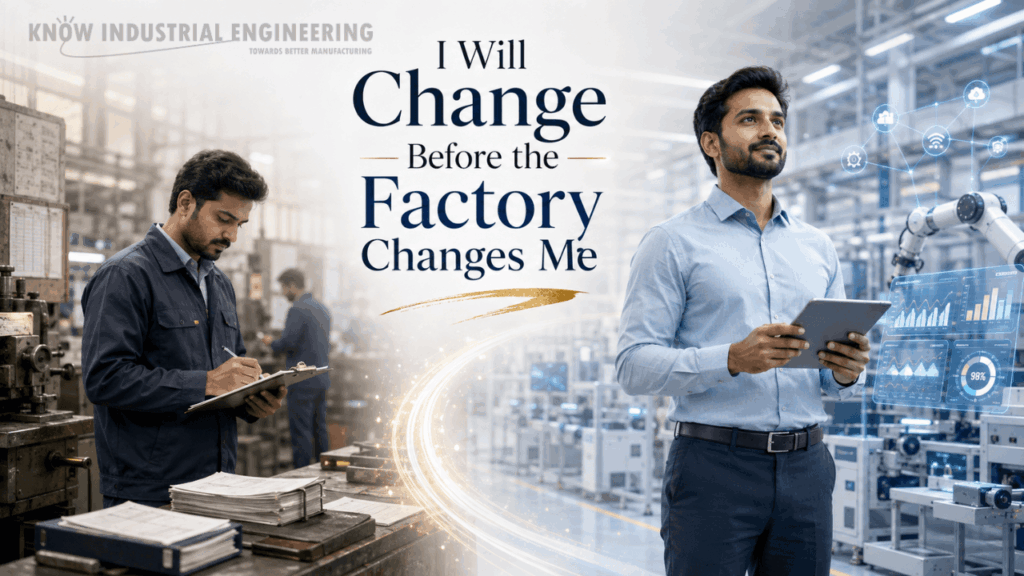
Walk into a factory today and you may see operators filling production sheets, supervisors updating Excel files, engineers conducting time studies with stopwatches, planners manually changing schedules, quality teams maintaining separate records, and managers waiting until the next morning to understand what actually happened on the shop floor.
Much of this may still look normal.
But it will not remain normal forever.
Manufacturing is entering a period where the way factories are planned, operated, monitored, maintained, and improved will change significantly. Artificial intelligence, connected machines, digital work instructions, manufacturing execution systems, machine vision, autonomous material movement, predictive maintenance, robotics, and real-time analytics are gradually becoming part of industrial operations.
The exact speed of adoption will differ from factory to factory.
But the direction is becoming clear.
What you see inside factories today is going to change.
The more important question for manufacturing professionals is therefore not:
“Will my factory change?”
The better question is:
“What role will I play when it changes?”
The Factory We Know Today Is Not the Final Version
Think about how factories operated twenty or thirty years ago.
Production information was recorded mainly on paper. Communication happened through physical documents and meetings. Machine performance was often calculated manually. Production planning depended heavily on individual experience. Quality inspection relied more on human observation. Maintenance teams responded mainly after breakdowns.
Many of these practices have already changed.
Today, even relatively traditional factories use ERP systems, barcode tracking, CNC machines, sensors, automated inspection equipment, digital dashboards, collaborative robots, and cloud-based applications.
The transformation is not going to stop here.
Imagine a production line where a customer order automatically enters the manufacturing system.
The system checks available materials.
It identifies machine capacity.
It verifies manpower availability.
It generates a production sequence.
Operators receive digital work instructions.
Machines automatically report production quantities.
Quality results are captured directly.
Material consumption updates inventory.
Maintenance systems monitor equipment health.
Management can see the factory’s actual condition without waiting for somebody to prepare a report.
This is not simply automation.
It is the gradual creation of a connected and intelligent manufacturing system.
Your Excel Sheet May Not Remain Your Job
This is an uncomfortable point, but manufacturing professionals should think about it.
Many jobs today contain a large amount of repetitive information processing.
An engineer may spend hours collecting production data.
Another person consolidates spreadsheets.
Someone prepares graphs.
Someone calculates efficiency.
Someone follows up with departments.
Then another person prepares a PowerPoint presentation explaining what happened.
Technology is becoming increasingly capable of doing much of this automatically.
If your professional value comes mainly from collecting data, copying information, preparing routine reports, or performing repetitive calculations, your work will eventually face increasing automation.
That does not mean the profession disappears.
It means the profession must move upward.
Instead of spending three hours calculating yesterday’s efficiency, the engineer should be asking:
Why is efficiency low?
What constraint is limiting output?
Can the process be redesigned?
Can manpower be optimized?
Can production sequencing be improved?
Can the information flow be automated?
Can the problem be prevented before tomorrow’s production begins?
Technology should remove low-value work so professionals can concentrate on higher-value decisions.
Do Not Compete With Software
A calculator is better than a human at calculation.
A database is better than a human at remembering thousands of records.
A computer is better at continuously monitoring large volumes of production data.
Artificial intelligence may become better at detecting patterns across millions of data points.
Trying to protect work simply because “this is how we have always done it” is unlikely to work forever.
Instead, manufacturing professionals should learn how to use these technologies to improve the factory.
An industrial engineer who understands processes and understands digital systems becomes extremely valuable.
A production engineer who understands manufacturing constraints and knows how to translate them into software requirements becomes valuable.
A quality engineer who understands inspection methodology and machine vision becomes valuable.
A maintenance engineer who combines equipment knowledge with predictive analytics becomes valuable.
The opportunity is not in competing against technology.
The opportunity is in connecting manufacturing knowledge with technology.
Become the Person Who Drives the Change
Every transformation needs people who understand both the existing system and the desired future system.
That person does not necessarily have to be a software developer.
You do not need to become an AI researcher.
You do not need to become a robotics programmer.
But you should understand enough to ask the right questions.
For example:
Why are operators writing this information manually?
Can the machine provide this data automatically?
Why are we entering the same information into three different systems?
Can these systems communicate?
Why do we discover shortages only when production stops?
Can material requirements be predicted earlier?
Why does management receive yesterday’s production report today?
Can the information be available in real time?
Why are we manually preparing production schedules?
Can capacity, demand, material availability, and manpower be considered together?
These questions are where transformation begins.
The change agent is often simply the person who looks at an existing process and asks:
“Why are we still doing it this way?”
Manufacturing Knowledge Will Become Even More Important
There is another misunderstanding surrounding digital manufacturing.
Some people assume that once AI becomes powerful, manufacturing knowledge will become less important.
In many situations, the opposite may happen.
Software can process information, but someone must define what the information means.
Consider capacity analysis.
A system can calculate numbers.
But someone needs to understand cycle time, utilization, setup losses, product mix, alternate routing, bottlenecks, manpower constraints, and realistic production conditions.
Consider line balancing.
Software can distribute tasks.
But someone must understand precedence relationships, operator movement, workstation design, ergonomic limitations, variability, and takt requirements.
Consider production scheduling.
Algorithms can produce schedules.
But manufacturing professionals must understand priorities, material constraints, tooling availability, maintenance windows, process dependencies, and shop-floor realities.
The strongest future professionals may therefore be those who combine:
manufacturing fundamentals + systems thinking + digital capability.
Do Not Wait Until Management Announces “Digital Transformation”
One of the biggest mistakes professionals can make is waiting for their company to formally start a transformation program.
Transformation can begin much smaller.
Study one repetitive reporting activity.
Understand its data flow.
Identify unnecessary manual entries.
Explore whether information can be captured automatically.
Learn how APIs work.
Understand databases at a basic level.
Explore MES systems.
Understand what AI can and cannot do.
Learn how machine data is collected.
Understand how digital production tracking works.
Experiment with dashboards.
Learn basic automation tools.
Most importantly, continue strengthening your manufacturing fundamentals.
Small learning efforts accumulate.
When your organization eventually begins a larger digital transformation, you will not be seeing these concepts for the first time.
You may become one of the people capable of leading it.
Change Will Also Create Resistance
Factory transformation is rarely only a technical problem.
People may say:
“We tried something like this earlier.”
“Operators will never use it.”
“Our factory is different.”
“Excel is enough.”
“This is too complicated.”
“We have been working this way for twenty years.”
Some concerns may be legitimate.
Technology implemented without understanding the process can create expensive failures.
Digitizing a bad process does not automatically make it a good process.
That is exactly why experienced manufacturing professionals are important.
The goal should never be technology for the sake of technology.
The sequence should be:
Understand the process. Simplify the process. Improve the process. Then digitize intelligently.
Your Career Can Move With the Factory
Factories will continue evolving.
Some jobs will disappear.
Some responsibilities will become automated.
Many existing roles will change.
And entirely new roles will emerge.
Manufacturing professionals therefore have two choices.
We can watch the transformation happen around us and eventually learn whatever the new system forces us to learn.
Or we can understand where manufacturing is heading and prepare ourselves before the transformation reaches our workstation.
You already possess something extremely valuable: knowledge of how factories actually work.
Now combine that knowledge with the technologies shaping modern manufacturing.
Ask questions.
Experiment.
Learn.
Improve systems.
Challenge unnecessary manual work.
Understand data.
Understand automation.
Understand AI.
And most importantly, understand the factory as one connected system rather than a collection of separate departments.
Because whether we are ready or not, what we see inside factories today is going to change.
So instead of becoming someone affected by that change,
become the change agent who helps create the factory that comes next.
Now or Never
We’ve got your back on your manufacturing journey — Stay in touch
Follow us for step-by-step guidance, templates, and insights that save time and reduce mistakes.
Know Industrial Engineering Platform – Helping manufacturing industry professionals worldwide since 2019
Discover more from Know Industrial Engineering
Subscribe to get the latest posts sent to your email.