

Manufacturing professionals are trained to solve problems. A machine stops, we restore it. A line misses its target, we rebalance it. Rejection increases, we search for the root cause. Yet one important problem often remains unattended: Are we building only a successful process, or are we also building a successful career?
Many capable engineers spend years improving products, machines and factories but give very little attention to the direction of their own professional growth. They become excellent at meeting today’s targets without preparing themselves for tomorrow’s opportunities.
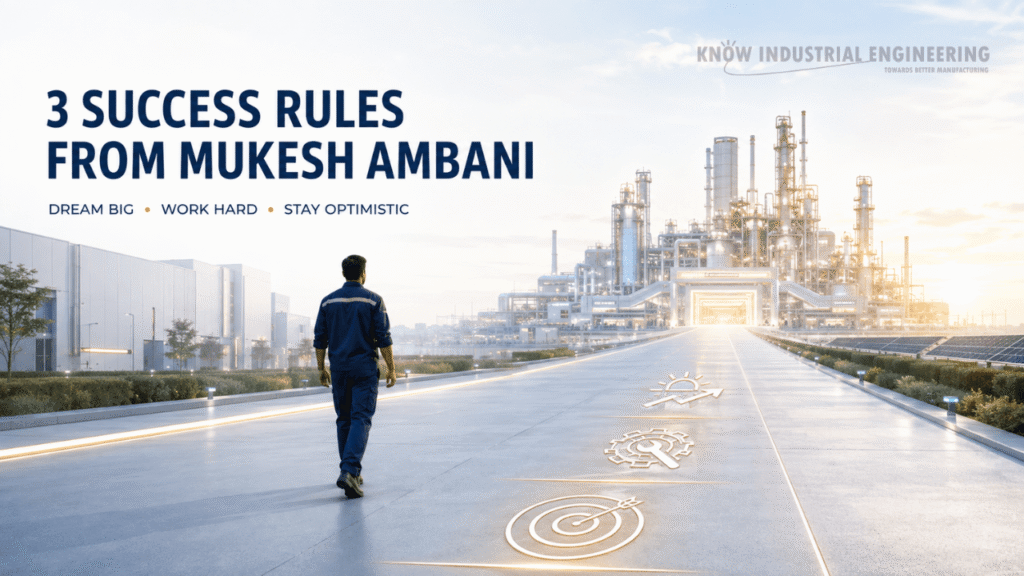
This is why three success principles shared by Mukesh Ambani are especially relevant to manufacturing professionals. They sound simple: dream big, work hard and remain optimistic. But when applied correctly inside a factory, they can change how an operator, engineer, manager or entrepreneur approaches work.
These are not motivational words to read and forget. Each one can become a practical operating principle for your career.
1. Dream Big, but Keep Your Attention on the Goal
Mukesh Ambani’s first lesson is to dream big and remain focused on the goal. When people focus on the goal, they begin finding ways around obstacles. When they focus mainly on their limitations, every obstacle starts looking like a reason to stop.
In manufacturing, dreaming big does not mean making unrealistic claims. It means looking beyond the immediate task and imagining a much better future state.
Consider a production engineer working on a line that records an Overall Equipment Effectiveness of 55 percent. A limited approach would be to target 57 percent because that appears achievable within the month. A bigger vision would be to ask:
“What would have to change for this line to operate consistently above 75 percent?”
That question produces a different quality of thinking. It may lead the engineer to study minor stoppages, tool-change losses, speed variation, material shortages, maintenance response time, operator movement and quality rejection. Instead of making one isolated improvement, the engineer begins seeing the production system as a whole.
The same principle applies to a career. A supervisor can aim to complete every shift without escalation. Or the supervisor can decide to become someone capable of managing the entire plant. An industrial engineer can continue preparing time-study sheets. Or the engineer can develop the ability to design complete production systems using automation, analytics, simulation and digital twins.
The bigger goal changes what you notice, what you learn and which responsibilities you volunteer to accept.
However, a big dream without a defined target remains only a wish. Translate the dream into measurable capability. If you want to become a plant head, identify the knowledge you still need in production, quality, maintenance, finance, supply chain and people leadership. If you want to build a manufacturing company, start understanding customers, product economics, sales, working capital and execution, not only the technical process.
Manufacturing example:
A quality engineer notices that customer complaints are repeatedly being closed through inspection and sorting. Instead of becoming better at containment alone, she sets a bigger goal: prevent the defect from being created. She studies the process, involves production and maintenance, identifies the source of variation and introduces a poka-yoke. Her contribution is no longer limited to finding defective parts. She changes the system that produces them.
That is what dreaming big looks like on a factory floor.
2. There Is No Substitute for Hard Work, and the Benchmark Must Be Global
Mukesh Ambani’s second lesson is direct: there is no substitute for hard work, and the aim should be to become the best not merely within India, but in the world.
In manufacturing, hard work is often misunderstood. Remaining inside the factory for long hours is not automatically hard work. Repeating the same activity with the same knowledge may create fatigue without creating growth.
Meaningful hard work combines discipline, learning and execution.
It means going to the shop floor before forming an opinion. It means verifying data instead of depending on assumptions. It means observing several production cycles, speaking with operators, testing countermeasures and following the result until the improvement becomes stable. It also means learning after working hours when the capability required for the next stage is not available in the current job.
Suppose two engineers are asked to reduce changeover time from 90 minutes. The first collects estimates, prepares a presentation and recommends that the team “plan better.” The second records the entire changeover, separates internal and external activities, studies every movement, prepares tools in advance, trials parallel activities and measures the next five changeovers. Both may be busy, but only one is doing the hard work that produces industrial improvement.
Global ambition adds another dimension. A factory should not accept a poor performance level simply because nearby competitors perform similarly. Customers increasingly compare cost, quality, delivery, traceability and responsiveness across countries. Therefore, manufacturing professionals must also compare themselves with world-class practices.
Ask stronger questions:
- Is our quality level globally competitive?
- Can our changeover time match the best plants in this process?
- Are our decisions supported by live, reliable data?
- Can our product and process meet international expectations?
- Are we learning the technologies that will define factories five or ten years from now?
Hard work becomes powerful when it is connected to a high standard. Otherwise, a person may work intensely only to preserve an outdated method.
Manufacturing example:
A maintenance team receives frequent breakdown calls from an ageing machine. Working hard only in the conventional sense means responding quickly every time it fails. Working hard with a world-class ambition means analysing failure history, identifying dominant failure modes, improving preventive maintenance, monitoring critical conditions and eliminating recurring causes. The first approach creates busy technicians. The second creates a reliable production system.
3. Remain Optimistic and Build Self-Confidence
The third lesson is to remain optimistic and believe in yourself.
Manufacturing rarely gives instant results. A trial may fail. Operators may resist a new method. Management may reject an investment proposal. Data may reveal that an improvement did not work. A promising automation project may face delays. In such situations, optimism is not pretending that everything is fine. It is the belief that the problem can be understood and that another solution can be developed.
This mindset is already built into good manufacturing practice. When a root-cause analysis disproves the first theory, the team does not declare that the defect is impossible to solve. It collects better evidence and tests the next cause. Careers require the same approach.
Self-confidence also does not mean believing that you know everything. Real confidence is the willingness to enter a problem you do not yet know how to solve, learn what is necessary and remain accountable for the result.
Imagine a young engineer asked to lead a digital production-tracking project. He understands the manufacturing process but has limited knowledge of software. A lack of confidence may make him avoid the opportunity. False confidence may make him proceed without involving specialists. Healthy confidence produces a better response:
“I do not know every technical detail yet, but I understand the problem, I can learn, and I can bring the right people together.”
That attitude expands careers.
Optimism is particularly important during transformation. Automation, artificial intelligence, robotics and connected manufacturing will change many traditional roles. Professionals who react only with fear will try to protect existing work. Professionals with confidence will ask how these tools can increase their contribution.
The future will not belong only to those who know the newest technology. It will belong to people who can understand factory problems, learn new tools and lead others through change.
The Three Rules Must Work Together
These principles are strongest when used as one system:
- Dream big to establish the direction.
- Work hard to build the capability and deliver results.
- Remain optimistic to continue through resistance, failure and delay.
A dream without hard work produces no result. Hard work without a big goal can keep a person busy in the wrong direction. Ambition and effort without optimism may collapse after the first major setback.
Consider a manufacturing professional who wants to create a zero-defect production line. The big dream sets the destination. Hard work drives process study, measurement, experimentation, standardisation and training. Optimism keeps the effort alive when early trials fail or people resist the change. The final achievement is not produced by one rule. It is produced by all three.
A Practical Challenge for Manufacturing Professionals
Before beginning your next working day, write down answers to three questions:
- What is the biggest result I genuinely want to achieve in my career or factory?
- What difficult, disciplined work am I avoiding even though it is necessary?
- Which recent setback must I convert into learning instead of treating it as a defeat?
Do not prepare impressive answers. Prepare honest ones.
Manufacturing teaches us that every output is the result of a process. Career success is no different. Mukesh Ambani’s three rules provide a simple process: choose a goal large enough to expand your thinking, work hard enough to develop uncommon capability, and remain optimistic enough to continue when the path becomes difficult.
Factories will change. Technologies will change. Job titles will change. But professionals who can dream beyond the present, execute with discipline and move through uncertainty with confidence will continue to create value.
Do not wait for the factory of the future to arrive and decide your role. Start preparing yourself to build it.
Now or Never
We’ve got your back on your manufacturing journey — Stay in touch
Follow us for step-by-step guidance, templates, and insights that save time and reduce mistakes.
Know Industrial Engineering Platform – Helping manufacturing industry professionals worldwide since 2019
Discover more from Know Industrial Engineering
Subscribe to get the latest posts sent to your email.