


For years, Industrial Engineering was seen as the field that kept factories running smoothly, cuts waste and made workflows cleaner. Important work, yes but honestly, it often stayed behind the scenes. In this article lets discuss how Industrial Engineering is entering its golden hour.
But something interesting is happening right now.
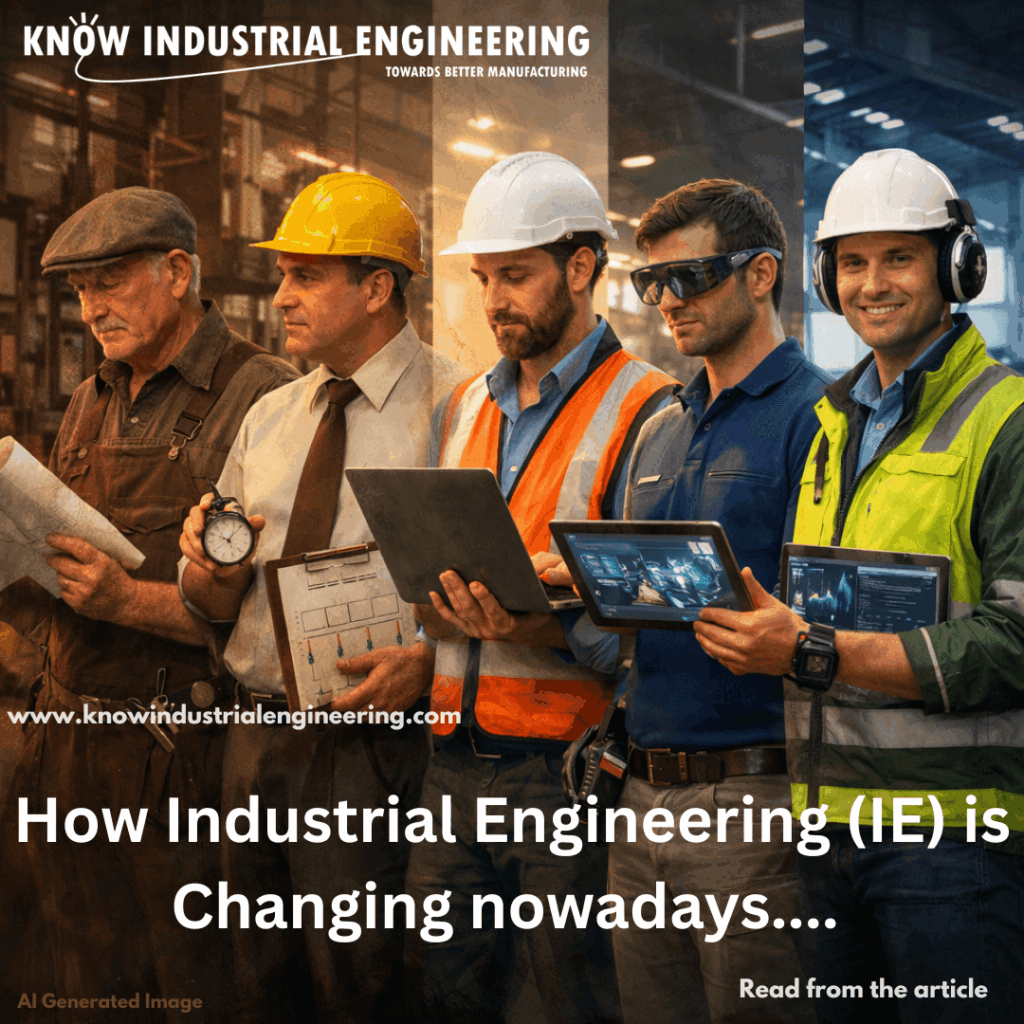
Technology is reshaping industries faster than any management philosophy ever did – AI in operations, sensor-packed machines, robotics that learn, supply chains that “feel” disruptions before they hit. And suddenly, Industrial Engineers are finding themselves at the center of the action.
Not because their old skills are outdated, but because they’re the only ones who understand the entire system end-to-end: people, processes, machines, data, and decisions.
Here’s what the future of IE actually looks like when you strip away the buzzwords and see the shift up close.
1. AI Isn’t Replacing IE, It’s Expanding It
Earlier, engineers waited for monthly reports to spot bottlenecks. Now, live dashboards and predictive models point them out before they happen.
Instead of asking, “Why did this fail?”
Future industrial engineers ask, “How do I make this fail-proof?”
AI becomes the assistant – IE remains the architect.
2. Factories Are Becoming “Living Systems”
If you walk into a next-gen plant, you’ll notice something subtle:
things respond.
Machines talk to each other.
Sensors alert you before anything breaks.
Robots slow down when a human steps close.
These are not future fantasies -they’re already happening in automotive, electronics, and logistics hubs.
And someone needs to stitch all these elements into one harmonious system.
That’s the industrial engineer’s new superpower.
3. Digital Twins May Replace the Notorious document Folder
Engineers have always loved flowcharts, SOPs, and time studies. But in truth, they age quickly.
A digital twin is basically a real-time mirror of your entire process – lets you test dozens of improvements without touching the shop floor.
It’s like having a safe sandbox to ask:
“How fast can I run this line without anyone getting hurt?”
“What happens if demand doubles overnight?”
IEs won’t just improve processes; they’ll simulate the future.
4. Human + Machine Is the New Productivity Formula
A lot of people worry that automation means fewer jobs. But in practice, it’s creating new ones – especially in roles where humans make judgment calls and machines handle precision.
Think:
- AR glasses guiding technicians
- Cobots assisting with fatigue-heavy tasks
- Skills training powered by VR
- Wearables alerting workers to unsafe zones
Instead of designing “worker efficiency,” IEs will design human experience + tech synergy.
5. Sustainability Is No Longer a CSR Line – It’s a KPI
Companies are now asked:
- How much energy do you waste?
- What’s your carbon footprint per batch?
- Can you reuse 30% of your scrap?
Industrial engineers will be the ones turning these questions into measurable, trackable, and improvable systems.
Green operations aren’t a trend; they’re becoming a business strategy.
6. Supply Chains Will Think Before Humans Do
The days of reacting to shortages are ending.
Modern supply chains:
- Detect delays
- Suggest alternate routes
- Forecast breakdowns
- Balance loads intelligently
If traditional IE improved warehouses, future IE will build resilient, self-adjusting supply ecosystems.
7. New Skills Will Define the Next Generation of Industrial Engineers
The job description is quietly evolving. Along with Lean and OR, engineers now need fluency in:
- Data interpretation
- Simulation tools
- Robotics basics
- Cloud and edge systems
- UI/UX for workflow design
- Sustainability frameworks
The future IE is part analyst, part technologist, part strategist.
So… What Does All This Mean?
Industrial Engineering isn’t getting replaced.
It’s getting upgraded.
The field is moving from:
- “Reduce cycle time” → Design intelligent workflows
- “Fix bottlenecks” → Prevent bottlenecks
- “Improve one line” → Optimize entire ecosystems
And for anyone entering or already working in this space, this is probably the most exciting time in decades.
This is not the end of industrial engineering.
This is its golden hour.
Now or Never
We’ve got your back on your manufacturing journey — Stay in touch
Follow us for step-by-step guidance, templates, and insights that save time and reduce mistakes.
Know Industrial Engineering Platform – Helping manufacturing industry professionals worldwide since 2019
Discover more from Know Industrial Engineering
Subscribe to get the latest posts sent to your email.