

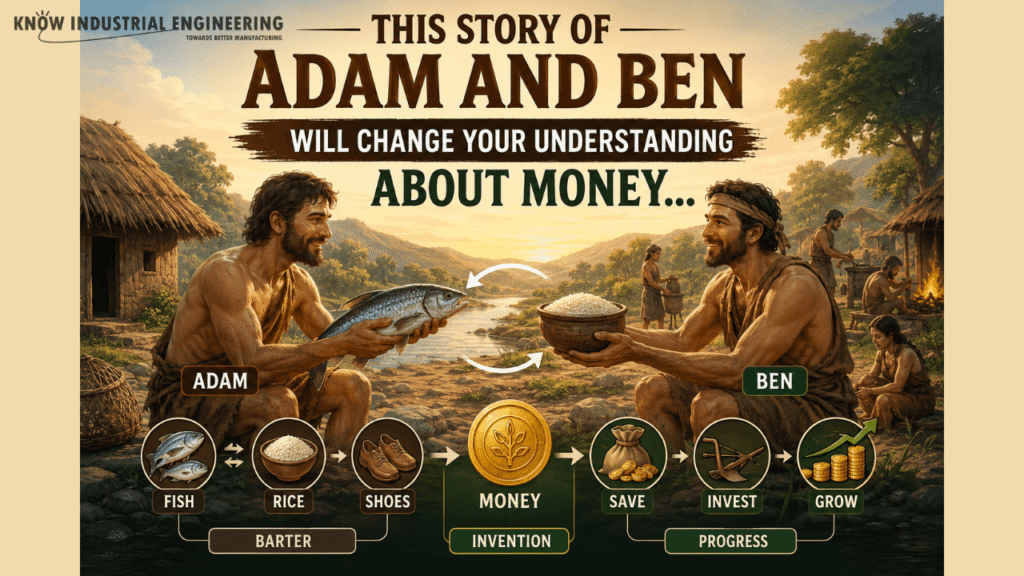
Imagine Earth thousands of years ago.
There is only one man. Let’s call him Adam.
Adam wakes up hungry.
He catches a fish.
He eats it.
Later, he wants shelter. So he cuts some wood and builds a small hut.
He wants water. He walks to the river and collects it.
There is no money.
And Adam doesn’t feel poor.
Why?
Because money has absolutely no meaning to him. If you gave Adam ₹1 crore, he might use the notes to start a fire.
What Adam actually wants is food, shelter, water and safety.
Then one day, another man appears.
Let’s call him Ben.
Ben is terrible at fishing. But he’s very good at growing rice.
Adam looks at Ben’s rice.
Ben looks at Adam’s fish.
Adam says,
“I’ll give you two fish for some rice.”
Ben agrees.
For the first time, they trade.
No money.
Just:
Fish ↔ Rice
And both become better off.
Adam doesn’t have to grow rice.
Ben doesn’t have to learn fishing.
Something important has happened.
They’ve started specializing.
Then Clara arrives.
Clara makes excellent shoes.
Adam wants a pair.
So Adam approaches Clara carrying fish.
“I’ll give you ten fish for those shoes.”
Clara shakes her head.
“I don’t like fish. I want rice.”
Adam has a problem.
He goes looking for Ben.
“Ben, give me rice for my fish.”
Then Adam takes the rice to Clara.
Fish → Rice → Shoes.
Adam thinks:
“This is ridiculous.”
As more people arrive, the problem gets worse.
One person makes clothes.
Another builds houses.
Another raises chickens.
Another makes tools.
Everyone wants something different.
So one evening, the village gathers around a fire.
Someone has an idea.
“What if we choose ONE thing that everybody agrees to accept?”
They choose a small, difficult-to-find metal coin.
They agree:
“If someone gives you these coins, accept them. Because everyone else will also accept them from you.”
Something extraordinary has just been invented.
Money.
The next morning Adam catches 20 fish.
He sells them.
Instead of receiving rice, shoes, chickens and wood…
he receives 20 coins.
Adam puts the coins in his pocket.
Now think about what just happened.
Adam worked today.
But he doesn’t have to consume the benefit today.
Three months later, Adam can take those coins to Clara and buy shoes.
In a sense, those coins are carrying the purchasing power from Adam’s past work into the future.
Adam starts looking at money differently.
He realizes:
“These coins aren’t food.”
“They aren’t houses.”
“They aren’t clothes.”
“But people will give me food, houses and clothes in exchange for them.”
That’s the magic.
Soon Adam saves 100 coins.
His neighbour spends every coin he earns.
Then winter comes.
Fishing becomes difficult.
Adam can still buy food because he saved some of his earlier purchasing power.
Now money has acquired another psychological meaning.
Safety.
Years pass.
Then Adam notices something else.
Ben is growing rice entirely by hand.
Adam tells him:
“If we had a better plough, you could grow three times as much rice.”
But building the plough requires 100 coins.
Adam has 100 coins saved.
He has a choice.
Keep the coins.
Or give them to Ben so Ben can increase production.
Adam gives Ben the 100 coins.
Ben buys materials.
A blacksmith gets paid.
Workers get paid.
The plough gets built.
Ben’s farm starts producing much more rice.
Ben earns 150 additional coins.
He gives Adam 110 coins back.
Adam suddenly realizes something that will eventually transform civilization:
His saved money helped finance productive activity, and that productive activity produced more value.
Now money isn’t only:
Work → Money → Spend
It can become:
Work → Money → Save → Invest → Production → More Money
The village keeps growing.
Eventually there are thousands of people.
Then millions.
Banks appear.
Companies appear.
Governments appear.
Stock markets appear.
Digital bank accounts replace many physical coins.
Today you can tap your phone and send ₹50,000 across a country in seconds.
But underneath all that complexity, Adam’s village is still there.
Someone produces something valuable.
Someone else wants it.
And money helps transfer purchasing power between them.
So whenever you see ₹1,000 in your bank account, don’t think only:
“I have ₹1,000.”
Think:
“I hold ₹1,000 worth of purchasing power that society currently agrees to accept.”
Now or Never
We’ve got your back on your manufacturing journey — Stay in touch
Follow us for step-by-step guidance, templates, and insights that save time and reduce mistakes.
Know Industrial Engineering Platform – Helping manufacturing industry professionals worldwide since 2019
Discover more from Know Industrial Engineering
Subscribe to get the latest posts sent to your email.