

OEE is a measure of how well a planned production time of an equipment is utilized to produce good products. It can be measured from 0% to 100%.
Its not only the equipment, effectiveness of achieving target number of good products, of all operations, whether it is manual, automatic or semiautomatic can be measured using OEE.
Now we shall discuss all factors which will affect OEE.
OEE Factors
OEE depends on three major factors.
- Availability
- Performance
- Quality
We will be discussing these three factors in the following sections…
How to calculate OEE
We can calculate OEE by two methods. One is very simple and less data is required. The other one requires more data, but for improving OEE we prefer second method since it has more data.
Lets move into detail…
OEE calculation – Method 1
Following formula is used for calculating OEE in this method.
OEE = (Total no of good products produced × cycle time) / Planned production time
But in this method, we did’t get an idea of which three factors of OEE is lagging behind. Only after knowing this information, we can improve those factors.
But for quick calculation we can use this method.
OEE calculation – Method 2
Initially we need to calculate three factors, Availability, Performance and quality.
And finally OEE is calculated by multiplying these three OEE factors.
Lets look in to these factors, in detail…
Availability
Availability factor is the measure of how well a planned production time is used for producing products.
Availability is calculated by the following formula,
Availability = Run time / Planned production time
Run Time is obtained by reducing idle time from Planned production time.
Run Time = Planned production time − Idle time
Idle time is the time for which machine is not running. This can be due to breakdown, material shortage, power failure, change over, etc.
Performance
Performance factor is a measure of how well a machine is able to maintain its cycle time for producing parts.
Performance factor is calculated by following formula,
Performance = (Cycle Time × Total products produced) / Run Time
Cycle time can be calculated by time study.
Quality factor
Quality factor measures how well a machine is able to produce good parts.
Quality factor is calculated by following formula,
Quality factor = No of good products produced / Total no of products produced
OEE calculation
OEE is calculated by multiplying the above three factors
OEE = Availability × Performance × Quality
If the equations for Availability, Performance, and Quality are substituted in the above and reduced to their simplest terms the result is:
OEE = (No of good products produced × Cycle Time) / Planned Production Time
OEE calculation Example
Now let’s walk through a complete example using the method 2 of OEE calculation. Here is data recorded for the first shift:
| Element | Time |
| Duration of shift | 480 minutes |
| Total break duration | 2 nos 15 minute tea breaks and 30 minute lunch break |
| Downtime | 55 minutes |
| Cycle Time | 40.0 seconds |
| Total no of parts produced | 490 products |
| Total no of parts rejected | 40 products |
Initially we need to calculate the following …
Planned production time
Formula for calculating planned production time is,
Duration of shift − Total break duration
480 minutes − 60 minutes = 420 minutes
Run time
The next step is to calculate the amount of time that production was actually running.
The formula is,
Run Time = Planned production time − Idle time
= 420 minutes − 55 minutes
= 365 minutes
No of good products produced
No of products produced = Total products produced − Total rejected nos
= 490 products − 40 products
= 450 products
Availability
Availability = Run Time / Planned Production Time
= 365 minutes / 420 minutes
= 0.869 (86.90%)
Performance
Performance = (Cycle Time × Total products produced) / Run Time
= (40.0 seconds × 490 ) / (365 × 60 seconds)
= 0.895 (89.5%)
Quality factor
Quality factor = No of good products produced / Total no of products produced
= 450 / 490
= 0.9183 (91.83%)
OEE CALCULATION
Finally, OEE is calculated by multiplying the three OEE factors.
Availability × Performance × Quality
= 0.869 × 0.895 × 0.9183
= 0.7142 (71.42 %)
OEE can also be calculated using a simple method (method 1).
Formula is,
OEE = (Total no of good products produced × cycle time / Planned production time
= (450 products × 40.0 seconds) / (420 minutes × 60 seconds) = 0.7142 (71.42%)
The result is the same in both cases. The OEE for this shift is 71.42%.
Thanks for reading
I am thankful to Mr. Abin Antony for contributing to this article.
If you know any subject that can be related to manufacturing industry or industrial engineering, you can earn some income by becoming article contributor of this website. For knowing more about it, please visit Join us page.
You don’t need to have any experience in article writing, just knowledge on the subject is needed.
Also you can know more about our team of article contributors by visiting the about us page.
About the Article Contributor

Visit his LinkedIn profile, for knowing more about him
Latest Articles from Know Industrial Engineering
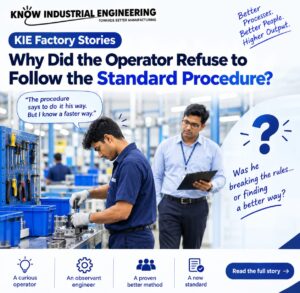
- KIE Factory Stories: Why Did the Operator Refuse to Follow the Standard Procedure?
 “The procedure says to do it this way. But I know a faster way.” The supervisor was ready to issue a warning. Advertisement The operator had been using a different method for months. And surprisingly, he was producing more parts than anyone else on the shift. The Industrial Engineer decided to watch him work. The difference was simple. The standard procedure required the operator to pick up a tool, turn around, complete the operation, and return the tool to its original place. The operator had rearranged his workstation. The tool was now within easy reach. He had removed unnecessary movement… Read more: KIE Factory Stories: Why Did the Operator Refuse to Follow the Standard Procedure?
 - What is A3 Problem Solving?A3 Problem Solving is a structured approach to understanding problems, identifying root causes, developing countermeasures, and monitoring results. It presents the entire problem-solving process on a single A3-sized sheet of paper, encouraging teams to focus on facts, logic, and clear communication. Advertisement In simple terms Instead of creating a long report about low production output, an Industrial Engineer summarizes: What is the problem? What do the facts show? Simple Manufacturing Example A production line has a target of 1,000 units per shift but produces only 850. The team investigates the losses and discovers that frequent material shortages account for a… Read more: What is A3 Problem Solving?
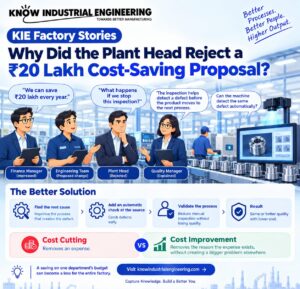
- KIE Factory Stories: Why Did the Plant Head Reject a ₹20 Lakh Cost-Saving Proposal?
 “We can save ₹20 lakh every year.” The Finance Manager was impressed. Advertisement The engineering team had proposed removing a small inspection step from the production process. It would reduce labor costs, shorten cycle time and increase output. The numbers looked excellent. But the Plant Head asked one question. “What happens if we stop this inspection?” The Quality Manager explained that the check helped detect a defect before the product reached the next process. “Can the machine detect the same defect automatically?” The team investigated. The machine could detect some defects, but not all of them. Removing the inspection would… Read more: KIE Factory Stories: Why Did the Plant Head Reject a ₹20 Lakh Cost-Saving Proposal?
 - What is 8D Problem Solving and How Does It Help Manufacturing Quality?What is 8D Problem Solving? 8D (Eight Disciplines) is a structured problem-solving method used to investigate recurring quality issues, identify root causes, and implement corrective actions that prevent recurrence. Advertisement It encourages teams to solve problems using evidence rather than assumptions. In simple terms Imagine a customer repeatedly receives defective components from your factory. Instead of inspecting more parts and blaming the operator, an 8D approach helps the team contain the problem, investigate why it happened, and fix the underlying cause. The 8 Disciplines D1 – Establish the Team: Bring together people with the right knowledge. D2 – Describe the… Read more: What is 8D Problem Solving and How Does It Help Manufacturing Quality?
- What is Gauge R&R and Why Is It Important in Quality Control?What is Gauge R&R? Gauge Repeatability and Reproducibility (Gauge R&R) is a measurement system analysis method used to determine how much variation comes from the measurement system rather than the parts being measured. Advertisement It evaluates two important sources of variation: In simple terms Imagine three quality inspectors measuring the diameter of the same metal component. Inspector A records 10.02 mm. Inspector B records 10.08 mm. Inspector C records 9.97 mm. Are these differences caused by the component, the measuring instrument, or the way each inspector measures? Gauge R&R helps investigate this question. Simple Example A shaft has a specified… Read more: What is Gauge R&R and Why Is It Important in Quality Control?
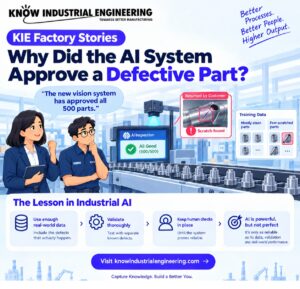
- KIE Factory Stories: Why Did the AI System Approve a Defective Part?“The new vision system has approved all 500 parts.” The Quality Manager looked relieved. Advertisement The factory had installed an AI-powered camera to detect surface defects. It was faster than manual inspection and never complained about repetitive work. But a customer returned a part with a clear scratch. The Quality Manager checked the inspection records. The AI had marked the part as good. “How did it miss something this obvious?” The team reviewed the images. The defect was clearly visible to the human eye. But most of the images used to train the system contained clean parts and only a… Read more: KIE Factory Stories: Why Did the AI System Approve a Defective Part?
- How to Grow Faster in Your Manufacturing Career: The Knowledge, Strategies and Decisions That Make the Difference
 Why do some manufacturing professionals become managers and plant heads while others remain in the same positions for years? Discover practical career-growth strategies that go beyond technical skills, experience and hard work. Two Engineers, Two Completely Different Careers Imagine two mechanical engineers joining the same manufacturing company on the same day. Advertisement Both have similar educational qualifications. Both are hardworking, sincere and technically capable. Ten years later, their careers look very different. One has become a Plant Manager, handling hundreds of employees, multiple departments, production targets and important business decisions. The other is still working as a Senior Engineer, waiting… Read more: How to Grow Faster in Your Manufacturing Career: The Knowledge, Strategies and Decisions That Make the Difference
 - What is Statistical Process Control (SPC) and How Does It Improve Quality?What is Statistical Process Control? Statistical Process Control (SPC) uses statistical methods to monitor a manufacturing process and understand how it changes over time. Advertisement It helps teams distinguish normal process variation from unusual changes that may require investigation. In simple terms Suppose a machine produces metal shafts with a target diameter of 10 mm. Even when the process is operating normally, measurements will vary slightly. SPC helps determine whether that variation is expected or whether something unusual may have happened. Simple Example A machine produces shafts with a target diameter of 10 mm. Measurements remain stable around the target… Read more: What is Statistical Process Control (SPC) and How Does It Improve Quality?
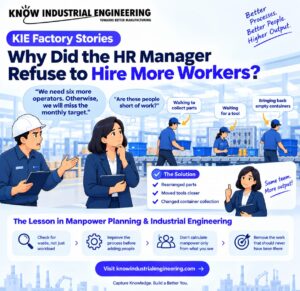
- KIE Factory Stories: Why Did the HR Manager Refuse to Hire More Workers?
 “We need six more operators. Otherwise, we will miss the monthly target.” The Production Manager was frustrated. Advertisement Orders were increasing, overtime was rising, and the team was struggling to keep up. HR started preparing the recruitment plan. But before approving it, the HR Manager asked to observe the production line. She watched one operator walk across the workstation to collect parts. Another operator waited for a tool. A third operator kept leaving the station to bring empty containers back. “Are these people short of work?” she asked. “No,” said the Production Manager. “They are short of time.” She watched… Read more: KIE Factory Stories: Why Did the HR Manager Refuse to Hire More Workers?
 - What is a Spaghetti Diagram and How Does It Improve Factory Layout?What is a Spaghetti Diagram? A Spaghetti Diagram is a visual tool used in Industrial Engineering to map the actual movement of people, materials, or equipment through a workplace. Advertisement The movement paths often look like tangled spaghetti, revealing unnecessary travel and inefficient layouts. In simple terms Instead of guessing why an operator spends too much time moving around, observe the actual work and draw the movement path on a layout. The diagram helps identify where time and effort are being wasted. Simple Example An operator assembles a product at Station A but must repeatedly travel to collect components from… Read more: What is a Spaghetti Diagram and How Does It Improve Factory Layout?
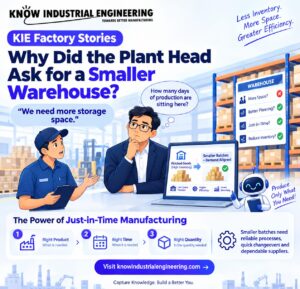
- KIE Factory Stories: Why Did the Plant Head Ask for a Smaller Warehouse?“We need more storage space.” The Warehouse Manager was convinced. Advertisement Finished goods were filling every available corner. Pallets were blocking aisles, and the team was struggling to find space for incoming material. His solution was simple. Build a bigger warehouse. But the Plant Head asked him to check one number first. “How many days of production are sitting here?” The team investigated. Some products had been waiting for weeks. Others had been produced months before the customer needed them. Then they checked the production plan. The factory was making large batches to reduce machine changeover time. But customer demand… Read more: KIE Factory Stories: Why Did the Plant Head Ask for a Smaller Warehouse?
- What is Performance Rating in Time Study?What is Performance Rating? Performance Rating is the assessment of an operator’s working pace compared with a defined normal performance level during a time study. Advertisement It helps an Industrial Engineer adjust observed time when the operator is working faster or slower than the normal pace. In simple terms If an operator completes a task unusually fast, the observed time may be lower than the time required at normal performance. If the operator is slower than normal, the observed time may be higher. Performance rating helps account for this difference. Simple Example Observed Time = 50 seconds Performance Rating =… Read more: What is Performance Rating in Time Study?
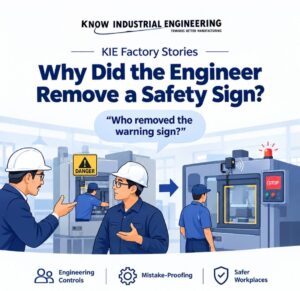
- KIE Factory Stories: Why Did the Engineer Remove a Safety Sign?“Who removed the warning sign?” The supervisor was not happy. Advertisement The sign had been placed beside a machine after a small hand injury. Everyone knew the area was dangerous. But the sign was gone. The safety engineer had removed it. The supervisor stared at him. “Why would you remove a safety warning?” The engineer pointed at the operator. “He was reaching into the machine every few minutes.” The operator explained why. “The machine jams here. I have to clear it.” The warning sign had not stopped him. It had simply become part of the background. So the engineer tried… Read more: KIE Factory Stories: Why Did the Engineer Remove a Safety Sign?
- What is Standard Time in Industrial Engineering and Why Is It Important?What is Standard Time? Standard Time is the time allowed to complete a specific task under defined working conditions, including appropriate allowances for fatigue, personal needs, and unavoidable delays. Advertisement It helps establish a realistic expectation for how long a properly trained operator should take to complete the work. In simple terms If an operator’s observed time is 50 seconds, that does not automatically mean the standard should be 50 seconds. Industrial Engineers consider: to determine the appropriate Standard Time. Simple Example Suppose: Observed Time = 50 seconds Performance Rating = 110% Normal Time: 50 × 1.10 = 55 seconds… Read more: What is Standard Time in Industrial Engineering and Why Is It Important?
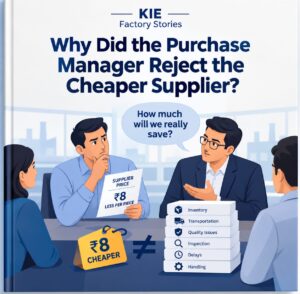
- KIE Factory Stories: Why Did the Purchase Manager Reject the Cheaper Supplier?
 “We can save ₹8 per piece if we switch suppliers.” The Purchase Manager expected everyone to agree. Advertisement Instead, the Plant Head asked one question: “How much will we really save?” The supplier’s price was lower. But there was a catch. The new supplier delivered in larger batches. That meant more inventory. Their lead time was also longer. So production kept extra safety stock. Then Quality found that the rejection rate was slightly higher. Nothing looked serious on its own. ₹8 cheaper. A little more inventory. A few more rejected parts. Some extra inspection. But when Finance added everything together,… Read more: KIE Factory Stories: Why Did the Purchase Manager Reject the Cheaper Supplier?
 - What are Value-Added and Non-Value-Added Activities in Manufacturing?What is a Value-Added Activity? A value-added activity is an activity that changes the product in a way the customer requires and is willing to pay for. Advertisement Examples: What is a Non-Value-Added Activity? A non-value-added activity consumes time, effort, space, or resources without increasing the value of the product. Examples: Simple Example Consider an assembly operation: Actual assembly: 40 seconds Waiting for material: 15 seconds Walking to collect components: 10 seconds Searching for the correct tool: 5 seconds Total time = 70 seconds But only 40 seconds directly changes the product. That means 30 seconds of the process time… Read more: What are Value-Added and Non-Value-Added Activities in Manufacturing?
- Stories from the Factory Floor #06“Just increase the speed.” That was the Plant Manager’s answer. Advertisement The customer order had increased, and the factory was struggling to meet the target. The team increased the machine speed. Output went up. Everyone was happy. For a while. Then the rejection rate started climbing. Operators were rushing. Minor breakdowns became frequent. Rework increased. By the end of the week, the factory was producing more parts… but shipping fewer good parts. An engineer finally asked: “What if speed was never the real problem?” They checked the process. The machine was already running close to its practical limit. The real… Read more: Stories from the Factory Floor #06
- What is Ergonomics in Manufacturing and Why Does It Matter?What is Ergonomics? Ergonomics is the science of designing workstations, tools, equipment, and tasks to fit the worker. Advertisement The goal is to make work safer, more comfortable, and more efficient. In simple terms Instead of asking: “How can the operator adapt to the workstation?” Ergonomics asks: “How can we design the workstation so the operator can work effectively with less strain?” Simple Example An operator performs a repetitive assembly task 600 times per shift. The workbench is too low, so the operator repeatedly bends forward. One movement may seem insignificant. But repeated hundreds of times can contribute to: Raising… Read more: What is Ergonomics in Manufacturing and Why Does It Matter?
- Stories from the Factory Floor #05“We have always done it this way.” The sentence came up three times during the meeting. Advertisement The team was discussing a process that required six approvals before a job could move to production. Nobody could explain why all six were still necessary. So they went looking. Approval 1 was added after a quality issue ten years ago. Approval 2 was added when a new manager joined. Approval 3 came from an old customer requirement. Approvals 4, 5 and 6? Nobody knew. The team checked the old records. The reasons had disappeared. Only the approvals remained. They tested the process… Read more: Stories from the Factory Floor #05
- What are the 8 Wastes in Lean Manufacturing?What is Waste in Manufacturing? In Lean Manufacturing, waste means any activity that consumes resources but does not add value from the customer’s perspective. Advertisement A process can look busy and still contain significant waste The 8 Wastes Simple Example An operator produces a component in 30 seconds, but spends another 10 seconds walking to collect material. The 10 seconds may not add value to the product. If this happens 500 times per shift: 10 × 500 = 5,000 seconds That’s about 83 minutes of potential productivity loss. Why It Matters Waste is often hidden inside normal work. A few… Read more: What are the 8 Wastes in Lean Manufacturing?
- Stories from the Factory Floor #04The customer called three times. Same complaint. Advertisement “The product is good, but it is difficult to use.” Quality checked the product. It passed every test. Production checked the process. Everything was within standard. Engineering checked the drawings. No problem there either. So the team visited the customer. They watched how the product was actually being used. Within ten minutes, they saw it. The operator had to turn the product around three times before he could install it. Every customer was doing the same thing. The product had been designed to be manufactured easily. Nobody had asked whether it was… Read more: Stories from the Factory Floor #04
- What are Manufacturing KPIs and Why Are They Important?What is a Manufacturing KPI? A Manufacturing KPI (Key Performance Indicator) is a measurable value used to understand how effectively a manufacturing process is performing. Advertisement KPIs turn production performance into data that can be monitored and improved. In simple terms Instead of saying: “Production seems slow.” A KPI helps quantify it: Output = 8,500 units Now the team has measurable information to investigate. Common Manufacturing KPIs OEE Overall equipment effectiveness Cycle Time Time required to produce one unit Productivity Output compared with resources used First Pass Yield Units passing without rework Availability Percentage of planned time equipment is available… Read more: What are Manufacturing KPIs and Why Are They Important?
- Stories from the Factory Floor #03“Don’t change anything.” That was the instruction from the Production Manager. Advertisement The line had been running for years. Same machines. Same layout. Same work method. Same problems. One young engineer noticed that operators were making the same small adjustment almost every hour. She asked why. An operator replied: “Because the machine doesn’t work properly without it.” “How long have you been doing this?” “About three years.” The engineer checked the machine settings. The adjustment was never part of the standard work. It existed only because operators had learned to compensate for the problem. The team finally fixed the root… Read more: Stories from the Factory Floor #03
- What is Performance Rate and Why Is It Important in Manufacturing?What is Performance Rate? Performance Rate measures how fast a machine or production process operates compared with its ideal or planned production speed while it is running. Advertisement It helps answer: “When the machine is running, is it producing as fast as it should?” In simple terms A machine may be available for production but still run slower than its ideal cycle time. For example: Ideal cycle time = 1 minute/unit If the machine runs for 400 minutes, ideal output would be: 400 units But actual output is only 360 units. Performance Rate: 360 ÷ 400 × 100 = 90%… Read more: What is Performance Rate and Why Is It Important in Manufacturing?
- Stories from the Factory Floor #02“Why are we producing this?” Nobody answered. Advertisement The Production Manager looked at the planning sheet. The order was approved. The material was available. The machine was ready. So production continued. Two days later, the finished products were sitting in the warehouse. Nobody was asking for them. The Planning Manager checked the customer order. The customer had changed the requirement three weeks earlier. But the old plan was never updated. The factory had spent: And produced something the customer no longer needed. Nothing had gone wrong on the shop floor. The machines worked. The operators worked. Quality was good. The… Read more: Stories from the Factory Floor #02
- What is Quality Rate and Why Is It Important in Manufacturing?What is Quality Rate? Quality Rate measures the proportion of produced units that meet the required quality standards compared with the total units produced. Advertisement It helps answer: “How much of what we produced was good without being rejected?” In simple terms If a process produces 1,000 units and 30 units are defective: Good units = 970 Quality Rate: 970 ÷ 1,000 × 100 = 97% Simple Example A production line produces: 2,000 units Out of these: Quality Rate: 1,940 ÷ 2,000 × 100 = 97% The remaining 3% represents units requiring rejection, rework, or other disposition depending on the… Read more: What is Quality Rate and Why Is It Important in Manufacturing?
- Stories from the Factory Floor #01“We don’t have it.” The Plant Head thought he had heard wrong. Advertisement “What do you mean?” “One component is out of stock.” The entire production line was ready. Operators were waiting. Machines were ready. Orders had to be shipped. The missing component? It cost less than ₹20. “Check the warehouse.” Nothing. “Check incoming material.” Nothing. “Call the supplier.” The delivery would arrive only in the afternoon. A tiny ₹20 component was now stopping products worth lakhs from being produced. The Purchase Manager pointed to the inventory report. Inventory had actually reduced. On paper, that looked like an improvement. But… Read more: Stories from the Factory Floor #01
- What is Voice of the Customer (VOC) and Why Does It Matter in Manufacturing?What is Voice of the Customer? Voice of the Customer (VOC) is the process of collecting and understanding customer needs, expectations, requirements, and feedback. Advertisement It helps manufacturers understand what customers actually value not just what the company assumes they value. In simple terms A customer may say: “I need faster delivery.” But the real requirement may be: VOC helps convert customer statements into measurable requirements. Simple Example Suppose customers frequently complain about product delivery. Instead of simply recording: “Customers are unhappy with delivery.” The company can identify measurable requirements: Now the manufacturing team has something it can measure and… Read more: What is Voice of the Customer (VOC) and Why Does It Matter in Manufacturing?
- What is PMTS and How Can It Help Determine Standard Time?What is PMTS? PMTS stands for Predetermined Motion Time System. Advertisement It is a work measurement technique used to determine the time required to perform a task by analyzing the basic human motions involved, rather than measuring the entire task repeatedly with a stopwatch. In simple terms Instead of asking: “How long did this operator take?” PMTS asks: “What motions are required to complete this job, and how much standard time should those motions take?” Simple Example Consider a simple assembly task: Each motion can be assigned a predetermined time value. The individual motion times are then combined to estimate… Read more: What is PMTS and How Can It Help Determine Standard Time?
- What is Heijunka and How Does Production Leveling Improve Factory Flow?What is Heijunka? Heijunka is a Lean manufacturing method used to level production volume and product mix over time. Advertisement Instead of allowing demand fluctuations to create highly uneven production schedules, the goal is to create a smoother and more predictable workload. In simple terms Imagine customer demand requires: A factory could produce all of A first, then B, then C. Heijunka encourages a more balanced sequence, such as producing smaller quantities of different products repeatedly. Simple Example Instead of: AAAAAA → BBB → C A leveled sequence could look more like: A → A → B → A →… Read more: What is Heijunka and How Does Production Leveling Improve Factory Flow?
- What is Production Mix and Why Does It Matter in Manufacturing?What is Production Mix? Production Mix refers to the combination and quantity of different products a factory produces during a specific period. Advertisement A factory may have enough total capacity, but the product mix can still create a capacity problem. In simple terms Suppose a factory produces: 🔹 Product A🔹 Product B🔹 Product C Each product may require different: Therefore, producing 1,000 units of Product A is not necessarily equivalent to producing 1,000 units of Product B. Simple Example A machine has 480 minutes/day available. Product A requires 2 minutes/unit.Product B requires 5 minutes/unit. If the daily requirement is: A… Read more: What is Production Mix and Why Does It Matter in Manufacturing?
- What is Production Planning and Control (PPC) and Why Is It Important?What is Production Planning and Control? Production Planning and Control (PPC) is the process of deciding what to produce, how much to produce, when to produce it, and how to control the production process to meet customer requirements. Advertisement In simple terms PPC connects: Customer Demand → Production Plan → Materials → Machines → Manpower → Production → Delivery Simple Example A company receives an order for 10,000 units to be delivered in 10 days. PPC needs to determine: If the required output is 1,000 units/day but the available capacity is only 800 units/day, the gap must be identified before… Read more: What is Production Planning and Control (PPC) and Why Is It Important?
- What is Queue Time and How Does It Affect Manufacturing Lead Time?What is Queue Time? Queue Time is the time a job spends waiting before the next operation can begin. Advertisement The product is not being processed during this period it is simply waiting. In simple terms Manufacturing time can include: Processing Time + Waiting Time + Movement Time + Inspection Time A product may require only 30 minutes of actual processing but spend several hours waiting between operations. Simple Example A component requires: Actual processing time = 60 minutes Total elapsed time = 270 minutes So the product spends much more time waiting than being processed. Why It Matters Excessive… Read more: What is Queue Time and How Does It Affect Manufacturing Lead Time?
- What is Downtime Analysis and How Can It Improve Production?What is Downtime Analysis? Downtime Analysis is the systematic study of when, why, and how long production equipment or processes remain unavailable for production. Advertisement Instead of simply recording: “Machine stopped for 2 hours.” Industrial Engineers investigate: “Why did it stop, how often does it happen, and what is causing the biggest loss?” In simple terms Not all downtime has the same cause. It may be due to: Simple Example A machine loses 120 minutes in one shift: Instead of treating all 120 minutes as one loss, the team can identify where the largest improvement opportunity exists. Why it matters… Read more: What is Downtime Analysis and How Can It Improve Production?
- What is Resource Utilization and Why Does It Matter in Manufacturing?What is Resource Utilization? Resource Utilization measures how effectively available manufacturing resources are being used compared with their available capacity. Advertisement Resources can include: In simple terms If a machine is available for 8 hours but actually produces for only 6 hours, its utilization is: 6 ÷ 8 × 100 = 75% The remaining 25% represents time that needs further investigation. Simple Example A production line has: Available time: 480 minutes/shiftActual productive time: 400 minutes Utilization: 400 ÷ 480 × 100 = 83.3% The important question is not simply why utilization is 83.3%. It is: “What happened to the remaining… Read more: What is Resource Utilization and Why Does It Matter in Manufacturing?
- Revisiting my Production Engineering subjects: SCT College, 2006–2010By Melvin Vincent In 2006, I joined Sree Chitra Thirunal College of Engineering, Trivandrum, to pursue B.Tech in Mechanical Engineering, Production Engineering stream, under the University of Kerala. I graduated in 2010. Advertisement Years later, I feel like opening those books again. Some lessons have stayed with me; others need a little refreshing. I am listing my subjects here, semester by semester, to reconnect with the learning that helped shape me as an engineer. Perhaps you will find a little of your own college days in this list too. Semesters I and II: The foundation Our first and second semesters… Read more: Revisiting my Production Engineering subjects: SCT College, 2006–2010
- Elon Musk Says Money Won’t Matter in the Future. Is It Already Happening?Elon Musk has repeatedly discussed a future where AI and robotics could create such enormous productivity that many goods and services become extremely abundant. It sounds difficult to imagine. Advertisement But look at the past. We may already have experienced smaller versions of the same transformation. Things That Once Cost Money but Are Now Almost Free Photography: Every photograph once required film and development. Today, taking another 1,000 photos on your phone costs practically nothing. Communication: International calls were once expensive. Today, we can make video calls across the world through the internet at almost no additional cost. Knowledge: Families… Read more: Elon Musk Says Money Won’t Matter in the Future. Is It Already Happening?
- What leads to recent 4.3 Million EVs Recall – An analysisIn August 2026, nine vehicle manufacturers announced recalls covering approximately 4.276 million electric vehicles in China. The recalls centred on a safety mechanism that was already present in the affected vehicles: the mechanical emergency door release. This was not simply a case of millions of defective door latches. The concern arose from what could happen during a serious collision, when several conditions occurred in sequence. Advertisement Under normal conditions, occupants open the doors electronically. A severe collision, however, can interrupt the vehicle’s low-voltage electrical supply. The electronic release may then become unavailable, leaving the occupant dependent on a separate mechanical… Read more: What leads to recent 4.3 Million EVs Recall – An analysis
- Understand how money works through This story of Adam and BenImagine Earth thousands of years ago. There is only one man. Let’s call him Adam. Advertisement Adam wakes up hungry. He catches a fish. He eats it. Later, he wants shelter. So he cuts some wood and builds a small hut. He wants water. He walks to the river and collects it. There is no money. And Adam doesn’t feel poor. Why? Because money has absolutely no meaning to him. If you gave Adam ₹1 crore, he might use the notes to start a fire. What Adam actually wants is food, shelter, water and safety. Then one day, another man… Read more: Understand how money works through This story of Adam and Ben
- Mukesh Ambani’s Three Success Rules Every Manufacturing Professional Should FollowManufacturing professionals are trained to solve problems. A machine stops, we restore it. A line misses its target, we rebalance it. Rejection increases, we search for the root cause. Yet one important problem often remains unattended: Are we building only a successful process, or are we also building a successful career? Many capable engineers spend years improving products, machines and factories but give very little attention to the direction of their own professional growth. They become excellent at meeting today’s targets without preparing themselves for tomorrow’s opportunities. Advertisement This is why three success principles shared by Mukesh Ambani are especially… Read more: Mukesh Ambani’s Three Success Rules Every Manufacturing Professional Should Follow
- Neuralink Blindsight: When the Brain Becomes the DisplayFor most of human history, vision has followed one path: light enters the eyes, the eyes convert it into signals, and the brain interprets those signals. Neuralink’s Blindsight is exploring a radically different possibility: What if visual information could reach the brain without depending on the eyes? Advertisement That idea makes Blindsight much more than a technology for restoring vision. If it succeeds and develops over time, it could become an early step toward a completely different relationship between humans, computers and machines. What is Neuralink Blindsight? Blindsight is a brain-computer interface being developed by Neuralink with the goal of… Read more: Neuralink Blindsight: When the Brain Becomes the Display
- Factories are going to change anyway – Before that change yourselfWalk into a factory today and you may see operators filling production sheets, supervisors updating Excel files, engineers conducting time studies with stopwatches, planners manually changing schedules, quality teams maintaining separate records, and managers waiting until the next morning to understand what actually happened on the shop floor. Much of this may still look normal. Advertisement But it will not remain normal forever. Manufacturing is entering a period where the way factories are planned, operated, monitored, maintained, and improved will change significantly. Artificial intelligence, connected machines, digital work instructions, manufacturing execution systems, machine vision, autonomous material movement, predictive maintenance, robotics,… Read more: Factories are going to change anyway – Before that change yourself
- Edge AI in Manufacturing: How Factories Make Intelligent Decisions Without Depending on the CloudEdge AI brings artificial intelligence closer to factory machines, cameras, sensors and production processes. Explore how it works, where it can be used and what manufacturers should evaluate before implementation.
- What Is Culture Actually? A Simple Explanation With Real Workplace ExamplesMany people think culture means company values, motivational posters, annual day celebrations, team photos, or a statement written on the office wall. But culture is much deeper than that. Advertisement Culture is not what a company says. Culture is what people actually do every day. In simple words: Culture is the repeated behavior of people inside a workplace. It is how people speak, decide, react, support, blame, solve problems, and behave when nobody is watching. Culture Is What People Accept and Repeat A company may say, “Quality is our priority.” But if defective parts are allowed to move forward just… Read more: What Is Culture Actually? A Simple Explanation With Real Workplace Examples
- Self Respect – You May Be Forgotten, But Do Not Forget YourselfThere is a powerful meaning behind the line: “You will be forgotten either way. So live in such a manner that, while you remain, you belong to yourself.” Advertisement At first, it may sound negative. But actually, it is a very practical reminder for life and career. Do Not Live Only for Recognition Most people spend a large part of their life trying to be accepted, praised, promoted, noticed, or remembered. Professionals do this too. We try to build a good image, impress seniors, satisfy customers, grow our business, and prove our value to others. There is nothing wrong with… Read more: Self Respect – You May Be Forgotten, But Do Not Forget Yourself
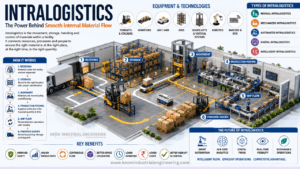
- IntralogisticsIn manufacturing, people often talk about production, quality, maintenance, automation and supply chain. But there is one area that quietly decides the speed of the entire factory: intralogistics. A factory may have good machines, skilled operators and proper planning. Still, if materials are not available at the right place, in the right quantity and at the right time, production will suffer. Operators will wait. Machines will stay idle. WIP will pile up. Space will become congested. Dispatches will get delayed. Advertisement This is where intralogistics becomes important. What Is Intralogistics? Intralogistics means the movement, storage, handling and control of materials… Read more: Intralogistics
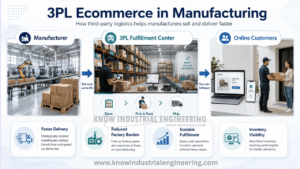
- 3PL Ecommerce in ManufacturingManufacturing is no longer only about producing goods and sending them to distributors. Today, many manufacturers are also selling directly to customers, dealers, retailers, and online buyers through ecommerce platforms. This shift has created a new challenge: how can a manufacturer manage storage, order picking, packing, shipping, and returns without disturbing core production activities? This is where 3PL ecommerce becomes important. Advertisement 3PL ecommerce means using a third-party logistics provider to handle ecommerce fulfillment activities. Instead of the manufacturer managing every online order from its own factory or warehouse, a 3PL partner stores the finished goods, picks customer orders, packs… Read more: 3PL Ecommerce in Manufacturing
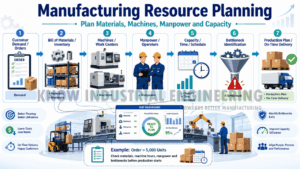
- Manufacturing Resource PlanningManufacturing Resource Planning is one of the most important activities in any factory. A factory may have machines, manpower, materials, tools, space and orders, but if these resources are not planned properly, production will still suffer. Many factories face the same problems every day. Advertisement Material is not available when production needs it.Machines are overloaded in one area and idle in another area.Manpower is arranged at the last minute.Production plans change frequently.Customer delivery dates are missed even when people are working hard. Most of these problems are not only production problems. They are planning problems. This is where Manufacturing Resource… Read more: Manufacturing Resource Planning
- AI and Lean six sigma
 This article is written by Shivani Kadam. She is experienced in Project Management. Walk into any manufacturing plant today and you will find two parallel conversations happening, related to AI and Lean six sigma. Advertisement The first is familiar. Teams are discussing scrap reduction, line balancing, cycle time improvements, OEE losses, and corrective actions. Whiteboards are filled with Pareto charts, fishbone diagrams, and action trackers. Lean Six Sigma continues to be the language of operational excellence. The second conversation is newer. It revolves around machine learning models, digital twins, predictive maintenance, computer vision, and generative AI. For many organizations, these… Read more: AI and Lean six sigma
 - Manufacturing Execution System: Meaning, Benefits, and Why Factories Need ItIn manufacturing, every minute matters. A machine waiting for material, an operator waiting for instruction, a supervisor searching for production status, or a planner working with outdated data can silently reduce factory performance. Many factories invest in machines, manpower, and materials, but still struggle because the information flow inside the factory is not clear. Advertisement This is where a Manufacturing Execution System, commonly known as an MES system, becomes important. A manufacturing execution system helps a factory control, track, and improve production activities in real time. It connects planning with actual shop floor execution and gives better visibility to managers,… Read more: Manufacturing Execution System: Meaning, Benefits, and Why Factories Need It











Now or Never
We’ve got your back on your manufacturing journey — Stay in touch
Follow us for step-by-step guidance, templates, and insights that save time and reduce mistakes.
Know Industrial Engineering Platform – Helping manufacturing industry professionals worldwide since 2019
Discover more from Know Industrial Engineering
Subscribe to get the latest posts sent to your email.

Clearly understood.
Thanks for the good work
It was really helpful. Thank you
Thank you Hilal for the positive feedback